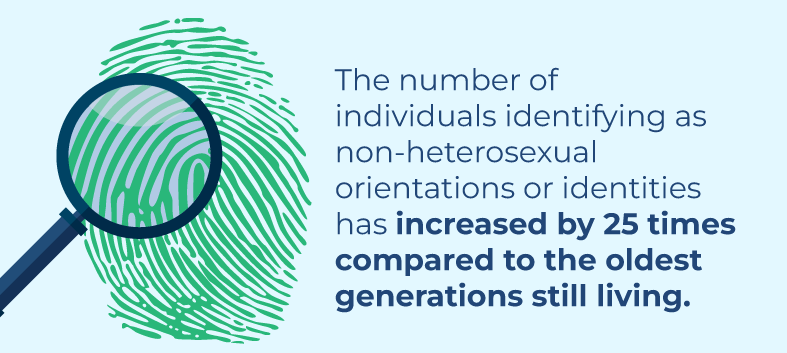
The number of individuals identifying as non-heterosexual orientations or identities has increased by 25 times compared to the oldest generations still living. According to Gallup polls, since the Silent Generation born before 1945, each subsequent generation has seen the rate of non heterosexual identification double.
The CDC’s 2023 survey on youth reports that slightly over 25% of today’s youth do not identify as heterosexual and recent polls show that 50% of college-aged women today identify as non-heterosexual (mostly bisexual). Younger generations also engage in much more fluid identity and orientation shifting than previous generations. If you work with middle school or high school populations, you will be familiar with a teen that is non-binary one week, trans the next, and bisexual a month after that.
Additionally, the number of sexual orientations overall has exploded with every nuance in interest, attraction, or identification resulting in a new label. Healthline lists 68 different identities or orientations ranging from no attraction at all to those who consider themselves to embody multiple genders at the same time. Furthermore, identification has expanded far beyond sexual orientation. Today’s youth may identify as therian, fictionkin, or otherkin as well, all alterhuman identities in which the individual believes they are not wholly human. For those unfamiliar with alterhuman identities, for many in these communities, this is not an imaginative belief. As the definition on Theri.app, a social app for the therian community states, “Like therianthropy, being otherkin is not a choice, a belief, or a role-play exercise. Otherkin describe their non-human identity as an intrinsic part of who they are.” Sometimes people are tempted to describe this as imaginative play, but here is a typical video of a teen combining furry costumes, social media, and identity statements.
There are actually debates within therian and otherkin communities as to if such feelings and identities are real, spiritual, a past life memory, connected to the multiverse, and other related explanations. Imagine a rudimentary understanding of Eastern Mysticism or the Marvel multiverse combined with a 30-second TikTok explainer by a high schooler on Hugh Everett's Many Worlds Interpretation of quantum mechanics.
For parents of children and teens who grew up in a different environment, this can all be incredibly confusing. What are all these different identities and orientations? 10 years ago, the 68 definitions on Healthline didn’t even exist and, while many parents are familiar with gay or lesbian identities, only a few know therian, fictionkin, or otherkin. This article will explore the neurobiology of identity and orientation as well as the ways in which American culture is evolving on this topic. We’ll then discuss how all of this factors into discussions around mental health.
For many Americans, there has long been a cultural assumption that identity and orientation are fixed elements of one’s self. This arises from an often unexamined unconscious belief in biological determinism, the idea that a person’s core personality or identity is rooted in immutable genetic expression. Americans have a long tradition of such beliefs starting with the arrival of the Pilgrims and Puritans who brought their perspective on Calvinistic predestination with them. This later merged with the prioritization of the scientific method leading to the eugenics movement in the US in the early 1900s.
Today, few Americans have even heard of the doctrine of predestination (the idea that God decides who will go to hell and who to heaven before one is even born), and eugenics is anathema to today’s mindset of acceptance and inclusivity. But the essentialist belief that humans are born a certain way and can’t change their essential nature is alive and well. Predestination, which evolved into eugenics, has now evolved into a vast oversimplification that biology at birth determines the self. Many Americans believe that genes can rigidly determine personality, identity, orientation, and behavior. This is not even remotely accurate, which is why identical twins, who have the same exact genes, do not have the same personalities, identities, or behaviors.
With that said, we don’t want to get bogged down in dry, scientific research on genes and neurobiology. For that reason, we’ll include that section at the end of this article. If you’d like to read that first, you can skim down to the section on How Do Genes Influence Identity below, then come back here.
The first very important point to realize, related to what we just alluded to, is that sexuality and identity are not biological realities in the sense of Lady Gaga’s “Born This Way.” Many of today’s youth embody this reality by being gender, identity, and orientation fluid. However, this is not new. Esteemed sex researcher Alfred Kinsey discovered this over sixty years ago, polling people on their identity and orientation over decades. Even back then, he found that “Just as our personalities, beliefs, and interests evolve throughout our lives, so can our attractions”.
Moreover, American culture has traditionally viewed sexuality as a binary attraction, either towards males or females. What’s surprising to many is that this is a view specific to modern American culture. Cultures in other times and places do not define sexual attraction in gender binaries.
In today’s Middle East, attraction is largely defined along a dominant versus submissive binary. Masculinity, and attraction for males, is defined as taking a dominant role in sexual acts. It doesn’t matter if that sexual act is with a man or a woman. As another example, readers may be familiar with the concept of pederasty in Ancient Greece where males had sex with younger men as well as women. This is because, analogous to the Middle East, in Ancient Greece, sexual attraction was not based on male vs female but on social status and hierarchy. For men in Ancient Greece, there were taboos around having sex with other adult men of the same social class, but not with slaves, women, or younger men as all were considered to be lower status in the social hierarchy of the day. Accordingly, these cultures’ respective languages had no word for homosexuality in the way we use it in modern American culture today in the sense that there was exclusive attraction based on sex/gender.
If readers are curious to explore vastly different conceptualizations of sexuality, orientation, and attraction across cultures, both geographically and temporally, we suggest some of the following content.
For many American readers, much of the above comes as culture shock. Most Americans assume attraction, orientation, and identity are fixed at birth and immutable, but even basic terms in English such as heterosexual and homosexual are nonsensical in other cultures which have no equivalent word in their language as sexuality is not thought of nor engaged in in terms of gender binaries.
This is also why we see such swings in sexual identity at the beginning of this article. Sometimes you will hear comments like, “Now that society is more accepting, we’re seeing the true numbers for various identities and sexual orientations.” But this doesn’t conform at all to the data or the neuroscience of behavior and identity. The fact that 50% of college-aged women today identity as non-hetersexual is a case in point for the sociocultural formation of such identities. And, of course, we don’t see similar numbers cross culturally. It’s only in WEIRD (Western, Educated, Industrialized, Rich, and Democratic) countries that we see these trends as they tend to share similar cultural discourses and narratives. Additionally, such categories don’t even apply to other cultures because the internalized conceptualizations of fixed gender identity or sexual orientation in the Western countries like the US do not have analogs in other countries and cultures.
This is why there is no biomarker for homosexuality, heterosexuality, or any other sexual identity or orientation. Not only do no biomarkers exist, but, even if genes determined human behavior (which they don’t), one would never be found because terminology regarding fixed sexualities are culturally specific concepts, not universal, biological realities.
This can be a difficult discussion to have in the US since sexual identity and orientation are particularly politically and emotionally loaded, so some readers will bring those biases to this article. However, here at Bricolage, we take a science-based approach to human behavior and mental health, focusing on root processes and mechanisms of change. Regardless of cultural landmines, we do what it takes to help our kiddos struggling with mental health issues.
Many in the LGBTQ+ community fear that recognizing the lack of scientific biomarkers or the culturally constructed nature of orientation and identity will lead to discrimination because these identities and orientations are then viewed as “a choice.” This is understandable, but ignoring reality disadvantages the community by undercutting its perspective. Additionally, as we’ll discuss, a lack of biological determinism also does not equate to “conscious choice.”
The fact of the matter is that our brains are always changing. From birth until the day we die, our brains are never permanently locked into a behavior, thought pattern, belief, method of learning, or anything else. In actuality, there are instances of people losing half of their brain then going on to live perfectly normal lives since their brain just used the other half to wire what it needed.
From a behavioral and identity standpoint, our brains are largely blank slates at birth (though there are limited preconfigured neural networks for learning numbers, language, and object permanence). This sometimes comes across as counterintuitive as, when we look at the animal world, we see birds that migrate in the winter, sea turtles that head towards the ocean immediately after birth, and chimpanzees that always establish hierarchies.
It’s perfectly logical then to assume humans also have some pre-wired behaviors, of which things like identity or sexual orientation may be among them, but this is not the case. Despite decades of research and tens of billions of dollars spent, no one has ever been able to find a biomarker for any behavioral framework. This can be confusing since we read so much about heritability in the news, but the methodological flaws in such approaches have increasingly invalidated such conclusions.
In truth, a primary difference between humans and other animals is that almost everything about us is the result of interactions with the environment around us after birth. It is our process of cultural learning and transmission rather than fixed behavioral patterns which has enabled us to become the dominant species on the planet.
Our brains have an incredible ability to constantly change, a concept referred to as neuroplasticity. This adaptability and lack of permanently fixed neural wiring is what enables us to live in the desert or the Arctic, to create art or study physics. It’s for this exact reason that different cultures have different conceptualizations of sexuality, different value systems, different beliefs. One thing we can say is truly fixed about our brains is that they are always plastic, which enables us to adapt to the environment, both physical and cultural, that we grow up in.
However, even though our brains always have the ability to change, this does not mean that change is easy or as simple as “a choice.” Identity constructs are often incredibly rigid from a neurobiological standpoint, as are many behaviors, thought patterns, and beliefs. One cannot simply “choose” to, overnight, adopt a new religion, political party, or even favorite sports team. Just as one can’t simply stop liking their favorite food or wanting what’s best for their children. Greatly oversimplifying, our brains both crystallize important or heavily used pathways and interlink them in incredibly dense networks of neurological connections. These two features alone make change incredibly hard. If readers want to understand the actual neuroscience behind the entrenchment process of frequently used pathways, a good introductory article can be found here.
Of course, there is an entire world of discussion around, “If one can change, no matter how hard that change is, should one?” This is not an article on the ethics of neurobiology, choice architecture, and change, so we won’t explore it. Instead, we’ll focus solely on a basic understanding of the underlying processes and those aspects relevant to mental health.
Many Americans believe that such categories as identity, sexual orientation, and behaviors are innate and immutable. This is inaccurate. We would simply provide some links to the scientific research and move on, but we’ve found that this is such a serious misunderstanding of human genetics, biology, and neurological wiring, that we’ll take a moment to address some key points.
It’s understandable that many Americans equate genes with behavioral determinism. The education most Americans receive regarding genetics often starts and ends with simplistic Mendelian inheritance. Brown eyes are dominant. Blue eyes are recessive. And physical traits such as eye color rarely change over the course of one’s life, so it’s easy to see why one might assume this applies to psychological features of our lives as well. Additionally, as discussed, many animals operate off of biological instinct. Birds fly south for the winter, sea turtles head for the sea immediately after hatching and know how to swim, and chimpanzees form and follow hierarchies. The logic then follows that humans reasonably operate in a similar fashion.
But this is not the case. Except for some simple frameworks such as an inherent ability to learn languages or recognize object permanence, human behavior is learned or internalized as one progresses through life. We do not operate off of instinct. Instead, what we refer to as instinct in our everyday lives is actually a learned response resulting from life experiences that’s become internalized as an unconscious process (Hebbian learning). Because it’s become a default, unconscious process outside of our conscious control, we often misunderstand it as something that was “always there.” Our brains have distinct processes for procedural learning that can, and often do, bypass conscious learning pathways.
And this is why one person may react to a threat by running away while another may fight while another may coolly assess the situation and ignore it. What makes one person angry, another may find humorous, while someone else may have no emotional response at all. These behaviors and responses are a direct result of what they’ve seen others around them do in similar situations or what they’ve found to work best for them in the past. They are not the result of differing genetic expression.
Beyond the fact that human brains are more plastic and are more of a “blank slate” compared to other animals at birth, gene expression is also not fixed. Genes express, don’t express, or semi express dependent on environmental stimuli. For example, a gene in a chronic stress environment may constantly express while that same gene in a non-stressful environment may remain inactive. We must be careful here as, even with this example, some people may be tempted to say, “Well, that gene always expresses during stress, so this is a predetermined response given a certain environment.” But this is not the case. By teaching oneself stress management techniques, that same individual can find themselves in environments they previously found stressful and no longer have that response. This is because gene expression is not fixed, but varies over the course of one’s lifetime for a variety of reasons. The study of changing gene expression is called epigenetics.
Without having a degree in biology or doing a deep dive into the science, we can see this play out in our lives every day. People can and do change significantly over time. The person we were in high school is not the person we are today. We all know someone who has had anger problems in the past, but became calm and reasonable later in life, someone who struggled with depression that no longer does, someone whose sexual orientation has changed over time, etc.
When it comes to identity, Americans are more likely to see these thoughts and behaviors as immutable. Especially for older generations, someone who identified as heterosexual in the past and then homosexual later in life will often make claims such as, “I hadn’t felt comfortable and just didn’t know why,” or “I always knew there was something different about me, I just didn’t know what it was.” Americans are very prone to creating identity narratives that are cohesive over the lifespan rather than recognize that identity, behavior, and thought patterns are all always open to change because human identity, thought, and behavior are not a result of fixed genetic expression. Ironically, it’s this exact essentialist zeitgeist which reinforces Americans’ fixed narrative building around personality, identity, and belief.
As opposed to some other cultures, such as those in East Asia, because Americans tend to have an essentialist view of self and identity, our brains tries to reduce cognitive dissonance by promoting cohesive lifespan narratives that then internalize and crystallize into one’s “truth.” However, reality is more complex and it’s often simply the case that new information and experience resulted in change.
When it comes to personality, identity, or behavior, our genes sometimes whisper lightly in our ear, so to speak, providing a very mild influence, but who we are and what we believe are malleable concepts that can change over time due to experience. This doesn’t mean they have to or will, the more rigid the internalized concept or belief, the less likely it is to change, but the neuroplasticity of our brains guarantees that change is always a possibility.
What connects trans, therian, fictionkin, and otherkin together is a belief related to body disconnection, either they’ve been born into the wrong body or their body is a mix of types. Trans identifying individuals are more likely to say that what’s in their head doesn’t match their birth sex. Therian and otherkin are more likely to describe a feeling of co-existence whether that’s phantom shifting or interdimensional or spiritual overlap.
There exist typical pathways of discovery. Because of the ubiquitous broader cultural conversation around trans identity, that is often the starting point with strong reinforcement coming from traditional media, schools, and social media.
There is a short logical leap from, “I’ve been born in the wrong gendered body” to “I’ve been born the wrong species.” There is a strong overlap between some LGBTQ+ communities and therian identity on platforms such as Tumblr, Discord, AO3 (Archive of Our Own), Wattpad, and subreddits such as r/Therian.
Again, a short leap of logic is all that’s needed to move from thinking one can be born the wrong species to believing one could have been born a fictional character or fantasy creature. In a sense, there can be comparisons made between any imaginative play among children such as pretending one is a superhero or playing house and dress up. Fiction and otherkin go beyond the imaginative play aspect and combine it with the trans logic of being born in the wrong body. Oftentimes, beliefs around reincarnation, other dimensions, and the multiverse are used as logical foundations for how this is possible.
As a parent, if you are looking to learn more about some of these identities and see what the kids (and even a few adults) are themselves saying, do searches on TikTok, YouTube, Reddit, and Tumblr for keywords such as “therian,” “alterhuman,” “fictionkin,” “otherkin,” “kinning,” and “phantom shifting.” There is significant overlap between corners of some LGBTQ+ subcultures and anime, furry, or fanfiction subcultures.
Following recent social media trends, there is also often overlap between these subcultures and self-diagnosis of mental health issues such as autism, ADHD, depression, and anxiety. For an example of the intersection of these subcultures, see this not atypical post on Reddit: https://www.reddit.com/r/otherkin/comments/1whckj4/i_need_help_to_understand_what_the_fuck_i_am/
Due to the strong reinforcement present on these online platforms, when discussing identity or mental health issues with your child or teen, you may want to restrict or limit access to one or several of the platforms. Teens especially, are far more influenced by their peer group than by adults. And our beliefs are most influenced by the people we like who we spend the most time with. A break from these influences can allow some distance and open the door for a more objective look at things.
Other links to explore:
https://www.reddit.com/r/otherkin
https://www.reddit.com/r/therianbutbetter
https://discord.gg/7g2UgyWvG (Therian Discord server)
https://archiveofourown.org/tags/Therian
https://www.youtube.com/hashtag/therian/shorts
https://www.youtube.com/hashtag/fictionkin/shorts
https://www.youtube.com/hashtag/otherkin/shorts
https://www.tiktok.com/search?q=%23therian&t=1789931091058
https://www.tiktok.com/search?q=%23otherkin&t=1789931126153
https://www.tiktok.com/search?q=%23fictionkin&t=1789931172144
How do we approach beliefs around identity and orientation from a mental health standpoint? Inherently, there is nothing harmful in any identity, trans, alterhuman, or otherwise. Humans hold a dizzying array of beliefs and, as we’ve cursorily explored, what seems odd or problematic in one culture is normative in another. As long as these beliefs do not create undue distress, excessive conflict, or other life problems, they are largely harmless. While the average American may consider someone who believes in the Ashtar Sheran Space Command, auras, Illuminati conspiracies, or any host of non-mainstream beliefs to be odd, these believers live quite normal and healthy lives. In a more relatable example for many people, some children have imaginary friends when they’re little, and these children grow up just fine.
Our beliefs about ourselves and the outside world regularly evolve. Some beliefs are stickier and longer lasting than others with the strongest ones potentially not changing over the course of a person’s entire life (and, as discussed, just because a belief doesn’t change doesn’t mean it can’t).
Where things get thorny is when beliefs clearly not based in reality continue for extended periods of time. A typical parent would not be overly concerned if their child had an imaginary friend in elementary school, but if that belief continued into middle or high school, most parents would become seriously concerned.
And believing in aliens or engaging in fantastical world-building through games like Dungeons & Dragons is qualitatively different from believing one is actually part wolf or part fantasy creature. When your child holds such beliefs outside of imaginative settings, it’s understandable to worry, “Is my child losing touch with reality” or “Do they have mental health issues?” These are questions any reasonable parent should ask.
Here at Bricolage, we are seeing a growing number of teens come in with these alternative beliefs about their identities. For the most part, these alterhuman beliefs are fairly harmless and most children will grow out of them on their own, but we do want to engage them in a way that affirms reality rather than physical impossibilities.
At this juncture, we’ll separate out identities such as homosexuality and heterosexuality from alterhuman and trans. Sexual attraction is part of the human experience and who one finds attractive is a subjective experience. There are as many types of attraction as there are people, which says nothing about objective reality. Alterhuman and trans, on the other hand, express a subjective experience in direct conflict with empirical reality. As such, we need to approach them differently from a therapeutic standpoint.
Just like we’d want to gently dissuade our child that their imaginary friend is real, it is equally advantageous to dissuade children from identifying as alterhuman or that they were somehow born in the wrong body. Are imaginary friends hurting anyone? No. But there are obviously advantages to having beliefs firmly grounded in empirical reality as well as preventing the social stigmatization and conflict that often result from fringe beliefs.
Some of the questions we explore with teens who hold these identities are:
We normally see three things with teens who hold these beliefs. It could be one or all three of these reasons.
For a growing number of teens today, identity is fluid and more rooted in feelings and beliefs rather than empirical reality. This is analogous to current cultural discourses on trans identities. While it is not possible for those born as one sex to become a different one, it is becoming more normative to feel like or identify as the opposite of one’s birth sex. In the same way, therian, fictionkin, and otherkin identities cannot become their other identity, but it is entirely possible to feel like and engage in behaviors related to that identification.
Therians, for example, will sometimes walk or run on all fours as a way to act out their animal identity (sometimes referred to by its fitness term - quadrobics). They also discuss feeling phantom shifts, which is the experience of physically feeling ear, claws, tails, wings or other appendages.
Those identifying as trans have related feelings and experiences. They strongly identify with their non-birth sex and may engage in hormone or surgical body modifications in order to more closely align with that identity.
Trans identities are also culturally specific. How females and males dress, act, and engage with the world around them varies from culture to culture. In the US, we consider skirts and dresses to be female attire, so a male identifying as female is often attracted to this kind of attire. But, in Scotland, it’s males who wear skirts (or kilts), and in Saudi Arabia, men wear a thobe which is a long, flowing robe that more resemble dresses. In the US, traditionally, men were responsible for finances and women did household chores. In Shanghai, China and Chambri Lakes, Papa New Guinea, it’s the opposite. For any given dress or behavior thought of as stereotypically male or female in the US, we can find a cultural or historical example where gender norms are the exact opposite.
The point here is that individuals identifying as trans are not identifying with their non-birth gender in general, but are identifying with a gendered representation of that sex specific to their culture’s time and place. For example, it is not uncommon to hear females identifying as males who felt uncomfortable with a perceived inequality in the way women are viewed in American society. They are attracted to the stronger, more dominant stereotypes of male interactions. Had these same females grown up in Shanghai or Chambri Lakes, they would, instead, feel more comfortable identifying as female.
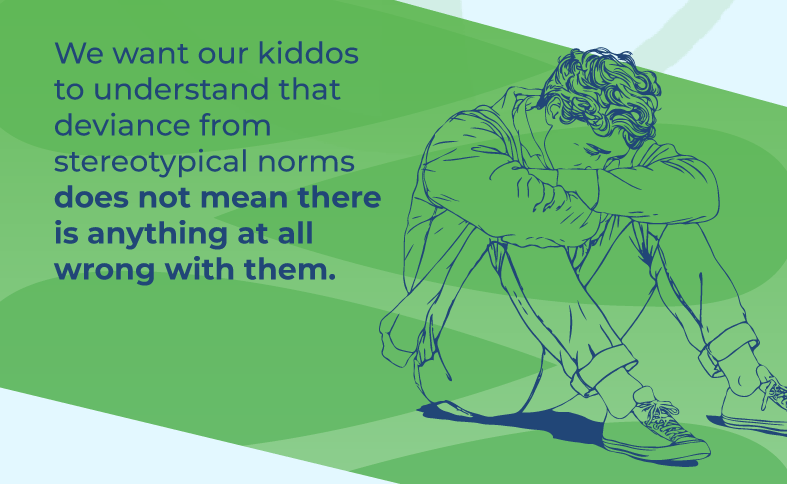
From a mental health perspective, this is often an important starting point. It is perfectly OK for a girl to engage in stereotypically American male behaviors such as playing with trucks, not wanting to wear dresses, and desiring to behave dominantly in social interactions. The same goes for boys interested in stereotypically girl behaviors or activities. Humans can feel and behave in all kinds of ways. We want our kiddos to understand that deviance from stereotypical norms does not mean there is anything at all wrong with them. Nor does it mean that they need to modify their body to conform to others’ expectations of their gender or to feel comfortable with themselves.
Importantly, becoming another sex isn’t possible. For someone born as a boy, they cannot be given a womb, reduce their bone density, or change their pelvic structure. We have the surgical capabilities to make cosmetic changes that mirror the other sex, but it is an approximation at best.
There are, of course, extremely rare instances of an individual born with many of the physiological features of a specific sex with one or two differences that are more common in the opposite sex. Additionally, rare instances of varied chromosomal combinations or hermaphroditism also exist. This can lead to the conclusion that, since physiological characteristics can sometimes vary at birth, then gendered mental characteristics could vary in a biologically predetermined fashion as well.
As logical as that sounds, neurobiology operates very differently from much of the rest of the body’s physiology. As we’ve seen, gender is a culturally defined, not a biologically defined concept. What constitutes gendered feelings, behaviors, and identity vary widely across cultures and time periods. This can be easily illustrated in a chart.
| Colonial American Female | Modern American Female | Colonial American Woman | Modern American Woman |
|---|---|---|---|
| XX Chromosome | XX Chromosome | Soft-spoken. Defers to men for political and vocational matters. | Outspoken. Engages all genders on similar terms. |
| Womb | Womb | Wears dresses. | May wear dresses, or pants, or suits, or anything else. |
| Ovaries | Ovaries | Focused on children and family. | May be focused on children and family or a career or anything else. |
| Produces milk without external hormones | Produces milk without external hormones | Uneducated in mathematics | Mathematical literacy and may be better than men. |
| Wider pelvis to aid childbirth | Wider pelvis to aid childbirth | Primary skills related to home life such as sewing and cooking. | Primary skills are anything they are interested in. |
Yuval Harari, in his book Homo Sapiens, provides an excellent illustration of changing norms comparing King Louis XIV of France in the 18th century and Barack Obama in the 21st century.

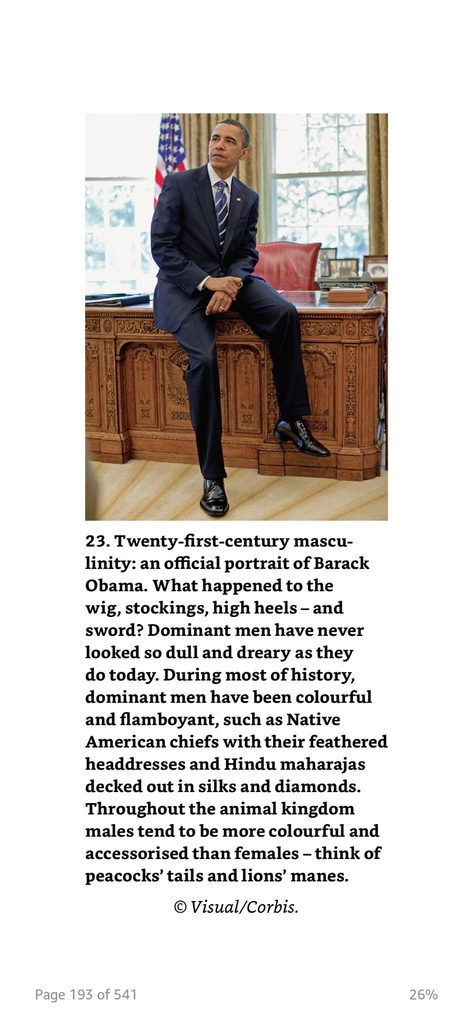
As we can see, gendered norms vary greatly over only a few generations but physiological traits do not. There is no part of our brains that are specifically female or specifically male as human brains build neurological structures as a result of engagement with the environment rather than as a result of genetic expression.
We should note that, sometimes this can get confusing in the scientific literature as neural imaging studies such as fMRIs may show similar areas of the brain sometimes firing in people with similar thoughts, identities, or behaviors. However, this is not a function of a pre-existing structural difference, but the standard mechanism of our brains using similar areas for similar types.
An illustrative example is someone who learns to play a musical instrument. Longitudinal studies of children have measured them before musical training and afterward. After 15 months of training, structural brain changes appeared alongside improvements in motor and auditory skills. Another two-year longitudinal study established that the groups did not have the relevant structural differences at baseline, but the children receiving music training subsequently developed measurable cortical and white-matter differences.
The same goes for any learning in the brain for any significant behavioral re-organization. It’s important to note that no two brains develop alike even if analogous regions tend to show some similarity in density or firing patterns. When we look at the individuals who received musical training, some similar areas of the brain showed similarity in neural activation, but NOT homogeneity. In short, it is not possible to do an fMRI scan and determine who can play the violin or not, just as it’s not possible to use a brain scan to determine someone’s political party, religion, psychiatric diagnosis, or identity. Brain scans can show some very broad similarities, but not definitive determination.
Because of the advancement of technological developments in cosmetic surgery, it is now possible to modify one’s body in ways that were undreamed of for the majority of human history. While hormones and surgical procedures cannot turn a male into a female or a female into a male, we now have the ability to more closely mimic the opposite gender through body modification than we ever have before.
This is quite important for trans identifying individuals to understand. Oftentimes, trans individuals feel uncomfortable in their bodies. Hormone therapies and surgical procedures are touted as a fix to this which is the equivalent of telling alterhuman identifying teens that the solution to their problems is to surgically modify their bodies to look more like a wolf, a dog, a dragon, or whatever animal they identify with. This too, is possible. We have the catman, parrotman, dragon lady, and others.
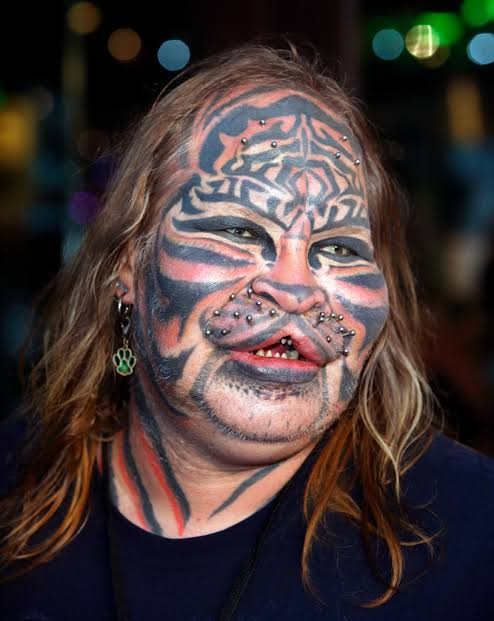
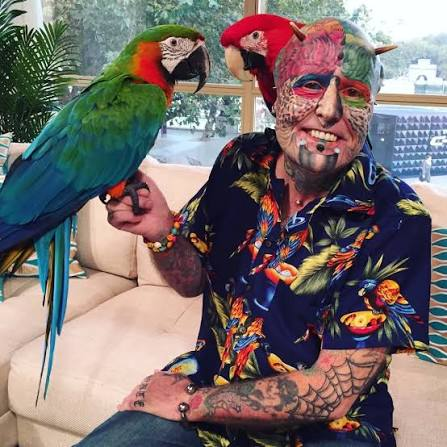
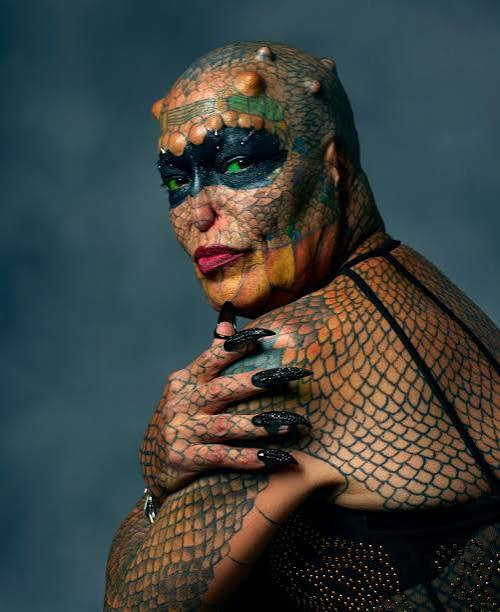
Are these individuals who engaged in extreme body modification to make them more animal-like happy with and comfortable with the body modifications they have made? According to some of the interviews linked above, they are. But, as parents or as a society, do we want to recommend this as the preferred pathway for kids or adults attracted to these fringe beliefs? Within American culture, where individual choice and freedom reign supreme, some people will certainly answer yes to that question.
And, ultimately, who’s to say? There is clearly a progression from things like today’s mainstream piercings and tattoos to extreme surgical body modification. Twenty years ago, tattoos were seen as fringe and taboo in professional settings. Now they are mainstream and you’re as likely to see a CEO with tattoos as you are a barista at the local coffee shop. Perhaps body modification will follow a similar progression.
Regardless of how body modification is viewed in the future, today, these are very serious choices and need to be addressed as such. They also must be understood in that context, as an extreme choice, not a necessity. Can one modify their face to surgically implant whiskers to be more catlike? With today’s surgical techniques, the answer is yes. Should one? That’s a much more complex question and should certainly factor in more than personal feelings. First and foremost, feelings change. Devout Christians become atheists later in life and vice versa. Republicans become Democrats and vice versa. We change our ideas about the world and ourselves constantly throughout life.
As we’ve discussed, personality, identity, behavior, and belief are not fixed in any kind of biological sense. No one is “born this way.” Instead, we construct and internalize all of these things over time. In real time, our brains are constantly wiring in the neurological pathways associated with these aspects of ourselves. The most used wiring becomes entrenched and more intricately interconnected over time, making it feel more “permanent” and certainly harder to change.
This is nowhere more evident than among today’s youth who increasingly have fluid identities in regards to traits Americans have traditionally regarded as fixed – gender identity, species identity, and sexual orientation.
The primary question becomes, “just because one feels a certain way at a particular moment in time, is it appropriate to act on it?” And a much more serious question is, “Should we act on it in such a way that creates permanent physical changes using highly invasive surgical procedures?”
Within American culture, there has been a significant shift towards validation of most feelings, beliefs, and perceptions an individual has about themselves or the world around them. This may often come up as discussions on lived experience with priority given to viewpoints from those who state they feel or experience a certain reality. We can see this adopted in these expanding identity communities like in our therian video linked in the beginning or this fictionkin video here.
Of course, there are cultural boundaries and limits to this. It’s not uncommon to hear that only trans identifying individuals can truly communicate the accuracy of the trans experience and non trans identifying individuals can’t possibly understand, so non trans identifying perspectives should be given shorter thrift. However, such prioritization of lived experience is not an ideal framework on which to base the validity of a given perspective. Using that same logic, would we agree that only Neo Nazis can understand their unique perspective and anyone not identifying as a Neo Nazi can’t possibly have a valid perspective that takes priority over theirs? Definitely not. We all understand that simply because one person holds a belief or opinion does not make them right, no matter how strongly they feel about it.
People are wrong all the time. That’s the value of engaging with others. It helps provide alternative perspectives, reality checks, and opportunities for alignment. It’s one reason group therapy is so effective within mental health settings. For many struggling with mental health issues, their current way of engaging with the world or themselves has become problematic. By engaging with the perspectives of others, they are able to encounter, consider, and potentially adopt alternative perspectives, behaviors, and strategies.
Here at Bricolage, we create safe spaces for teens to explore ideas of the self and the world. It is this exploration that is often crucial to find healing. We, of course, do not validate all perspectives. We have children who self-harm, children with suicidal ideation, children who act out constantly which causes excessive conflict in their lives. Blanket validation is not helpful to our kiddos.
Instead, we explore the value of different perspectives and ways of operating in the world. We not only discuss an array of ideas and solutions, but we also actively explore engaging with self and the world in different ways. We don’t just want to talk about it. We want to actively “try it out” so to speak. This can be a child who sees themselves and everything they do as a failure start to, instead, focus on things they’re good at and small wins that eventually lead to bigger wins. It can be encouraging a teen who’s constantly lashing out at adults and those in positions of authority to try and put themselves in the other person’s shoes, truly thinking through things from another’s perspective. It can be a trans or alterhuman identifying teen exploring what it’s like to accept biological reality and learning maybe they can feel comfortable embracing who they were born as.
When it comes to identity, we’ll often engage teens in a series of questions to truly explore constructions of self, consequences of beliefs and behaviors, as well as both short and long-term impacts of various choices:
Alterhuman body modification is not currently a culturally accepted norm, but sexual body modification can be, comparatively. These are extremely serious choices with lifelong, largely irreversible, repercussions. Here at Bricolage, we do not approach such discussions lightly with our teens. Most growth requires discomfort. As such, we do not shy away from difficult or challenging conversations. Upon turning 18, American adults can make whatever choices for themselves they feel most appropriate. When our teens come of an age to make such serious decisions, we ensure they are equipped with the knowledge and skills to have fully explored who they are, who they want to be, and the impact any choices they make will have on their lives. We aim to teach self-acceptance and self-love first as well as explore a variety of ways for teens to meet their needs and desires. Mental health is centered in our brains, not our genes or the rest of our bodies. Understanding that, we’ve found that compassionate therapeutic engagement almost always resolves issues of discomfort, depression, or anxiety, identity-related or otherwise.
When your child or family member has beliefs different from your own, this can lead to significant conflict. This is true of religion, politics, or philosophies on personal responsibility. As parents, family members, and friends, we are not required to believe the same as other people or agree with them. Instead, we want to be able to engage with those around us with respect and understanding, but this does not preclude the act of attempting to persuade others of our perspective or stance. Attempting to change people’s minds or get them to look at something from a different angle is a standard part of life.
May your child or family member struggle with conflict if there are differing perspectives? Very possible. And that’s OK.
May your child or family member experience feelings of rejection or hurt if you don’t fully support everything they do or believe in? Very possible and, again, that’s OK.
If you have a child that identifies as any of the myriad identities above, it’s up to you if you want to support that belief, challenge it, or engage in a combination of support and challenge. It’s no different than if they start having religious, political, or philosophical beliefs that are diametrically opposed to yours. Challenging or not agreeing with your child runs the risk of creating a rupture in the relationship, but, if approached with understanding and respect, can just as likely lead to a stronger and healthier relationship.
Most of us rarely agree on everything. And, when disagreements arise around deeply held beliefs, it’s easy to get elevated and upset, so we may be tempted to avoid these discussions or simply concede in order to not unduly upset the other person. It depends if that solves the situation or only allows it to fester. These are all things we explore in our treatment program here at Bricolage. We want our teens to be able to express themselves in a positive manner, handle challenges, and communicate from a place of calm, understanding, and respect. Through our bi-weekly family sessions, we also help the whole family using the same approach.
Here at Bricolage, we have several goals related to all of our teens, regardless of identity, orientation, or presenting symptoms. We will help them:

We hope you found this article enlightening and informative, giving you a better understanding of the fast evolving landscape on youth identity in America today. Is your teen struggling with mental health issues such as depression, anxiety, self-harm, suicidal ideation, or compulsive behaviors? Like most teens, do they sometimes feel lost navigating identity, emotions, relationships, or goals. We can help. Get in touch today.
All therapy starts with building trust and therapeutic alliance. We never challenge or explore alternative narratives until that foundation has been built. Once built, we will absolutely explore the advantages and disadvantages of using names and pronouns not reflective of one’s birth sex. As with any belief, it’s ultimately up to the individual to decide what is best for them, especially once they become a legal adult at 18. But, if teens in our programs decide to use pronouns not reflective of their birth sex, we want them to be fully cognizant of how that will impact their life for both better and worse. We also strongly emphasize that feelings aren’t facts. Just because we feel a certain way does not make it an empirical reality. No matter how many hormones they use or surgical procedures they undergo, they can never become a different sex, gender or species. If such medical procedures are something they feel will truly help them after turning 18, it will be their decision to make, but they need to go into that decision knowing these are largely cosmetic procedures, only able to change appearance, not biological reality.
Current federal and state law prohibit encouragement, support, or recommendations related to body modification for minors in a medical/therapeutic setting. In accordance with the law, we will never recommend such medical interventions. However, as discussed above, we will fully explore your child’s identity in supportive and compassionate ways while also challenging them to think outside their comfort zone and position identity as an internalized mental construct vs an immutable personality trait.
We approach sexual orientation as we would any other identity, belief, or behavior - with compassion and exploration. We help teens navigate life’s pathways to empower them to be the best version of themselves.
See our above discussion on genetics and biological determinism. In short, no. Genes don’t determine (although they do slightly have some influence on) our thoughts, behaviors, beliefs, personality, or identity. Our brains are plastic, so always capable of change. With that said, just because your child isn’t locked into a particular thought pattern, behavior, belief, personality, or identity for life doesn’t mean that they should or need to change, only that change is possible if that would enable your teen to become the best version of themselves.
See our discussion above on genetics and biological determinism. Human behavior is incredibly complex. Deeply seated beliefs, especially those related to identity and orientation, are entrenched neurological frameworks that have come to operate on a default, unconscious level. Just like all aspects of our personality, identity, and behavior, they can change over the course of our lives, but this does not mean such change is as simple as “making a choice.” One cannot simply wake up one day and decide to change their religion, the way they behave when stressed, or even their favorite sports team. Identity and orientation operate in similar fashions from a neurobiological perspective, but are even more deeply rooted and rigid for most people. You can read further here on how structural neuroplasticity stabilizes and entrenches beliefs and behaviors. Such change, while always possible, entails significant time, effort, discomfort, and distress. And, as stated in the answer to the previous question, just because your child isn’t locked into a particular thought pattern, behavior, belief, personality, or identity for life doesn’t mean that they should or need to change, only that change is possible if that would enable your teen to become the best version of themselves.
Yes, humans can believe almost anything.
Can they be happy doing so? Yes, they can. See the linked videos of catman, dragon lady, and others above. (You can always use ctrl+F or search on mobile to search by keyword).
No, believing one is part wolf does not make one part wolf. Believing one is other than their birth sex does not make one other than their birth sex. Feelings are subjective experiences not objective facts.
No, while beliefs can certainly become more entrenched over time, they are never “hardwired” or “permanently fixed” due to genetic expression or other biological mechanisms.
Bricolage Behavioral Health is strength-based, skills-based, evidence-based, and medication-light. We empower your child or teen to develop the skills they need to take control of their mental health with effective, science-backed therapy.
At Bricolage Behavioral Health we believe that whole family healing affords your child the best chance for long term mental health and can put your loved ones on the path to a healthier, happier life.
Bricolage Behavioral Health
3204 Long Prairie Road
Suite A
Flower Mound, TX 75022
Mon - Fri: 8:30 AM–9:00 PM
Sat & Sun: 9:00 AM–5:00 PM