Watching your teen lie isn’t just frustrating…
…it’s often confusing and hurtful.
And it can leave you wondering if something deeper is going on beneath the surface.
When dishonesty becomes repetitive or feels compulsive, most parents don’t just see a lie.
They see a pattern.
A breakdown of trust.
A behavior that just does not seem to make sense with who their child truly is.
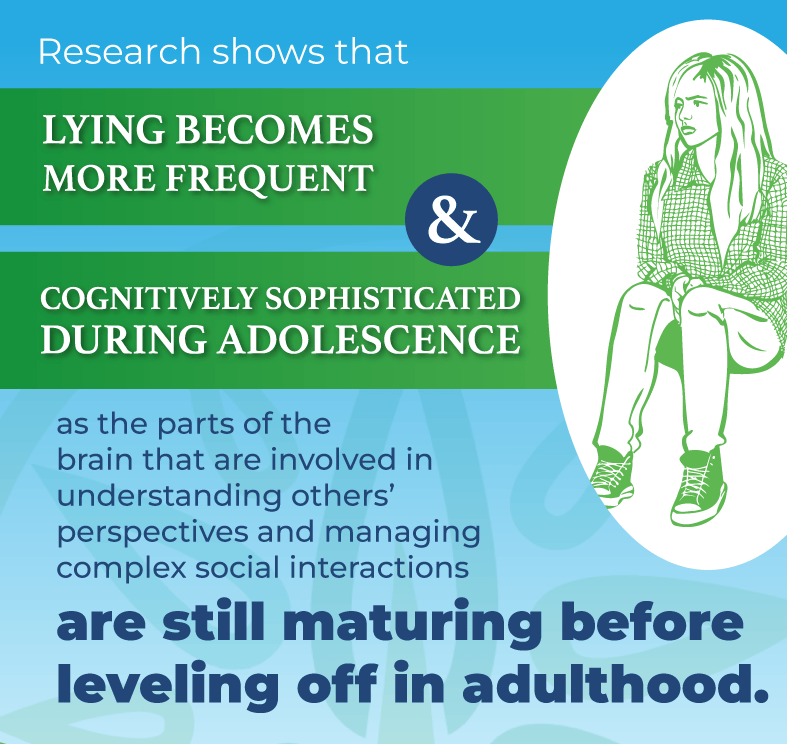
Part of what is happening comes down to how the adolescent brain develops. Research shows that lying becomes more frequent and cognitively sophisticated during adolescence. Like any behavior, repetition leads to learning and reinforcement. Basically, lying becomes easier, teens get better at it, and it can cement into a habit if overrelied upon.
At Bricolage Behavioral Health, we understand how dishonest behaviors are often pointing to underlying stress, unmet emotional needs, and even coping strategies that have not yet been replaced with healthier ones. That is why we work with teens and families to understand the why behind the behavior, not just the behavior itself. So teens can build honesty, connection, and real-world skills that stick.
When a teen lies once, it can feel situational.
When it happens repeatedly, it can start to feel personal.
It’s important to remember that repeated lying is rarely about being bad or manipulative in a calculated way. More often, it is more of a coping pattern that has been reinforced over time. If lying successfully reduces stress, avoids conflict, or protects social standing (even just once) the brain registers it as useful.
In TV police dramas, we always here, "what you say can and will be used against you." For habitual liars, they've taken this advice to heart. If they did something wrong, the logic goes, lie and they might get away with it. Tell the truth and they're definitely in trouble.
If the strategy has worked for them in the past, they are more likely to repeat it so that it becomes a habit.
Instead of asking, “Why does my teen keep doing this?” it can be more productive to ask, “What is this behavior accomplishing for them?” Patterns form when a behavior is able to solve a problem … even if it just creates bigger problems later on.
We want to be careful as parents that we aren't allowing opportunities for reinforcement. Sometimes, it's easier to accept the lie then engage in conflict with our children, but this sends the wrong message. Even simple things like letting your child win at a board game by cheating seems harmless, but it sends the message that deception is acceptable for your child to get what they want.
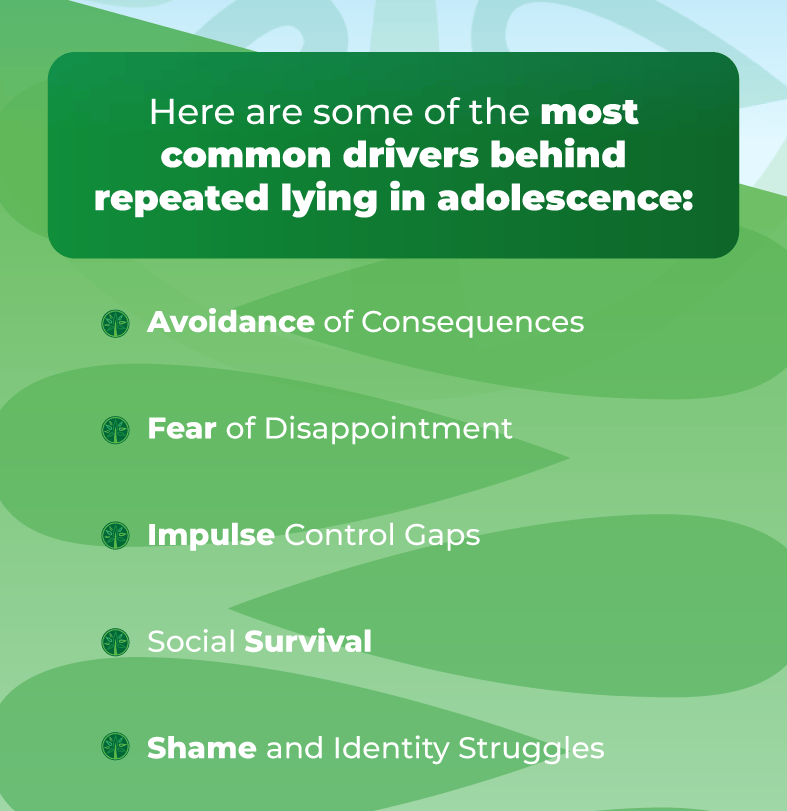
Here are some of the most common drivers behind repeated lying in adolescence:
Over time, if lying can consistently reduce anxiety, prevent immediate fallout, or improve perceived social status, it can start to become an almost automatic reaction for your teen – not even pausing to evaluate other options. That’s when parents start to describe it as “compulsive.” But labeling the behavior without understanding its function often just makes it worse.
Increased surveillance, harsher consequences, or repeated lectures may temporarily suppress the lying. But they don’t build the skills needed to replace it.
Lasting change happens when teens are able to develop healthier ways to handle their fears, pressure, and conflict. That requires emotional regulation skills, problem-solving tools, and a safe environment where honesty does not automatically equal humiliation or escalation.
When we understand the reinforcement cycle, we can respond differently. And when we respond differently, teens get the opportunity to practice something new.
When parents say, “My teen lies about everything,” it often feels completely sweeping and absolute. But not all dishonesty serves the same purpose, and not all of it carries the same meaning.
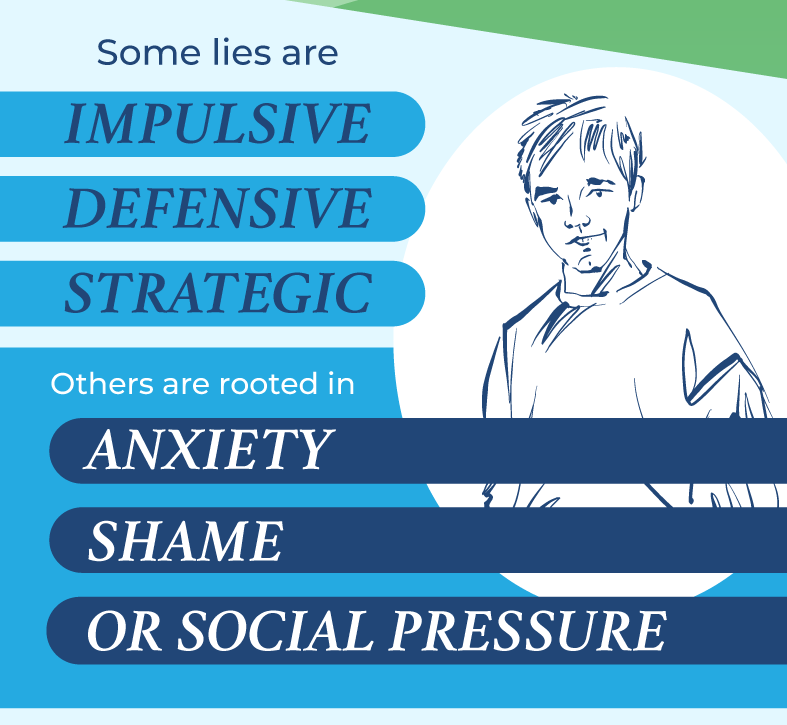
Some lies are impulsive.
Some are defensive.
Some are strategic.
Others are rooted in anxiety, shame, or social pressure.
Lumping them together can make the behavior feel bigger and more intentional than it actually is. Breaking them apart allows you to respond with more precision and less panic. From a developmental perspective, adolescence is a time when abstract thinking and perspective-taking are expanding. Teens become better able to understand how others see them. That cognitive growth can make dishonesty more sophisticated, but it also means the motivation behind it is more complex.
Here’s a clearer look at the different patterns parents may be seeing:
| Type of Lying | Definition | Common Motivation | Example |
|---|---|---|---|
| Avoidant Lying | Dishonesty used to escape consequences or conflict | Fear of punishment or escalation | “I already turned that assignment in.” |
| Impression Management | Shaping the truth to protect image or gain approval | Fear of disappointing others | “Yeah, I studied a lot for that test.” |
| Social Exaggeration | Embellishing details to fit in or increase status | Peer acceptance and belonging | “I was invited, I just didn’t go.” |
| Omission | Leaving out key details rather than fabricating | Minimizing fallout | Not mentioning they failed a quiz |
| Habitual or Reflexive Lying | Automatic dishonesty even when truth would be easier | Learned coping response to stress | Denying something small that’s easily verifiable |
| Defensive Lying | Denial in the face of perceived accusation | Protecting self from shame | “I didn’t take it,” when confronted |
What is important to notice is that most of these are self-protective. They are attempts to reduce discomfort, maintain connection, or avoid shame. While that does not make them harmless, it does mean that they are rarely rooted in malice.
When parents understand which behavior they are actually seeing, their response can shift. An avoidant lie may need safety and predictable consequences. An impression-management lie may require reassurance and realistic expectations. A habitual pattern may signal anxiety or deeper emotional dysregulation.
Responding the same way to every type of lie often escalates the situation.
Responding to the function behind it opens the door to skill-building.
The goal is not just to stop the lie. It’s to understand what the lie is trying to solve, and help your teen develop a healthier way to solve it instead.
When lying becomes frequent, automatic, or emotionally charged, most parents jump to character concerns.
Is this manipulation?
Is this defiance?
Is this just who they are now?
More often than not, chronic lying in adolescence is less about morality and more about self-regulation. It’s a coping strategy that has become strengthened over time. If dishonesty reduces anxiety, avoids conflict, or preserves connection even temporarily, teens learn that it “works” – and whatever works tends to be used on repeat.
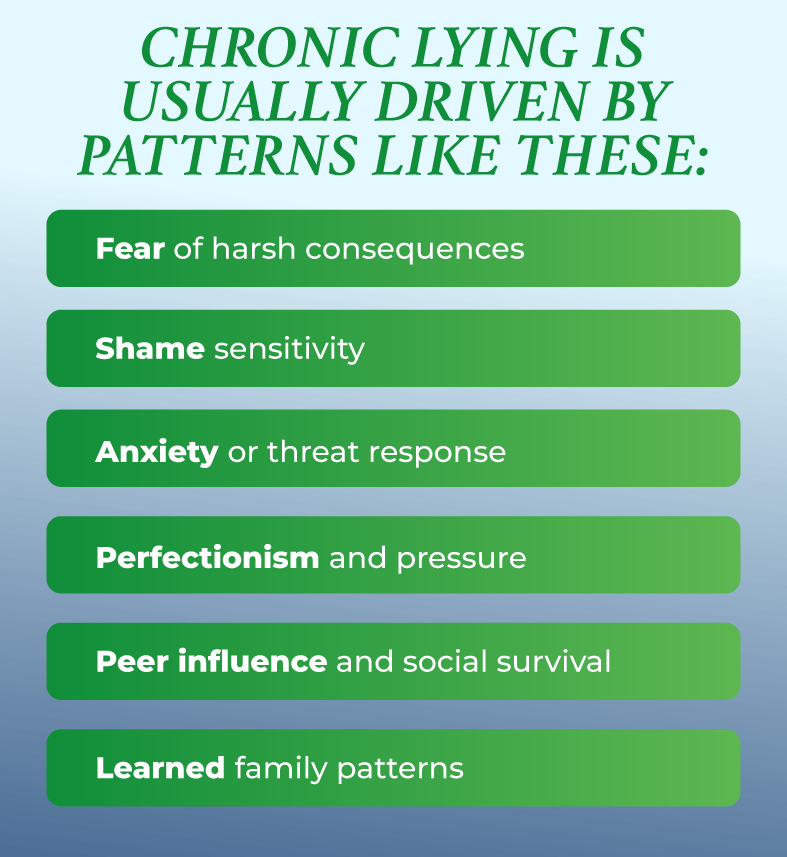
Chronic lying is usually driven by patterns like these:
The important thing to remember is this: behavior that repeats is behavior that is being reinforced. That doesn’t mean it’s healthy. It means it’s meeting a need.
When parents look past the surface and ask, “What is this lie protecting?” the conversation changes. And when the conversation changes, so does the opportunity for growth.
The term compulsive liar can feel heavy.
It suggests intent.
Personality.
Even permanence.
But through adolescence, that label is often premature.
Teens are still developing their impulse control, emotional regulation, and executive functioning. What looks like compulsion may actually be anxiety. What feels deliberate may be a reflexive defense.
Instead of asking whether your teen is a compulsive liar, consider whether you’re noticing patterns like these:
If several of these apply, the issue may not be dishonesty alone. It may point toward other underlying factors, such as:
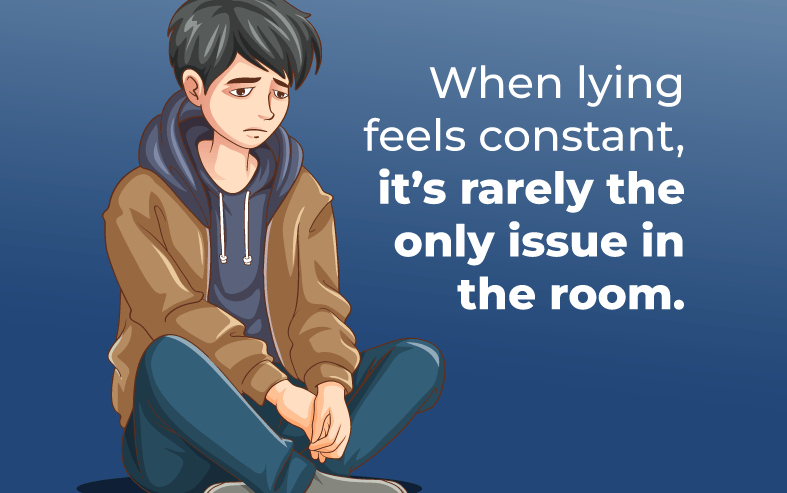
When lying feels constant, it’s rarely the only issue in the room.
The goal is not to excuse dishonesty. It’s to correctly identify what’s fueling it. Because if something deeper is driving the behavior, addressing only the lying will never fully resolve the cycle.
It is exhausting to feel like you can’t trust your own child.
But escalation rarely fixes the dishonesty.
It will more often strengthen it.
When parents respond with interrogation, heightened emotion, and unpredictable consequences, the teen brain often doubles down on its protections. If lying was meant to avoid discomfort, and the reaction -instead- increases discomfort, the recurring response will harden.
A more effective approach focuses on rebuilding safety and skill:
At the end of the day, rebuilding honesty is less about catching lies and more about increasing safety. When teens believe they can tell the truth without losing connection, their need for protection decreases.
Dishonesty may be the behavior you see.
But trust grows when the real need underneath it is finally addressed.
When dishonesty becomes a cycle instead of an isolated behavior, families often start to feel stuck.
Conversations turn into investigations…
Trust erodes…
… and everyone becomes more guarded.
At this point, the goal is no longer just getting your teen to tell the truth. The goal becomes understanding what the lying is trying to protect and interrupting that practiced cycle to help your teen build skills that make honesty feel safer than avoidance.
At Bricolage Behavioral Health in Flower Mound, treatment is designed to address patterns like these at their roots. We don’t focus on labeling teens. We focus on the why behind the behavior, and we create structured environments where new patterns can be practiced consistently.
Below is how that process works.
For teens whose behavior significantly interferes with school, family stability, or emotional regulation, PHP provides structured, full-day therapeutic support while still allowing them to return home each evening and maintain their nighttime routines.
This level of care includes:
This structure helps to interrupt the reinforcement cycles. When a teen practices accountability, self-regulation, and peer interaction in a supportive environment, the brain begins to form new defaults.
For teens who have the desire to remain in schoolpart time – but could use consistent therapeutic intervention – IOP offers several hours of treatment multiple days per week.
This allows teens to:
IOP works well when learned habits are present but not yet destabilizing daily functioning. It creates accountability in your teen, without removing them from their natural environment entirely.
Patterns rarely exist in isolation.
Family communication, expectations, and responses all influence how behaviors are encoded.
Through structured family sessions, parents learn:
This alignment between therapy and home is critical. Without it, progress can stall.
This is where Bricolage is fundamentally different.
Most programs rely on a round-robin style talk therapy, where one teen will speak while the rest passively listen. That format can build insight … but insight alone rarely changes behavior patterns like chronic lying.
But whole-group engagement is active.
Teens participate through focus tasks, pair work, collaborative problem-solving, role play, and (most importantly) real-time feedback.
They do not just talk about honesty, accountability, and emotional regulation...
…they are able to actually practice those skills in real time.
Why that matters:
When a teen practices regulation and honesty in real time, with support and structure, the brain encodes that experience differently. Over time, those repeated experiences begin replacing old defensive patterns.
Change becomes something they do, not just something they understand.
When lying becomes a learned habit, it is not a character flaw of your teen.

At Bricolage Behavioral Health, our whole-group engagement helps your teen actively practice honesty, emotional regulation, and problem-solving in real time. Our treatment is strength-based and goal-oriented; and our team includes a dedicated teen psychiatrist who works directly with our therapists and families to understand the full picture, not just the surface behavior. Care at Bricolage is collaborative and skill-based, and is designed to translate into real life at home and school.
If your family is ready for support in the Flower Mound area, call 469-968-5700 to learn how we can help your teen move forward with confidence.

Bricolage Behavioral Health is strength-based, skills-based, evidence-based, and medication-light. We empower your child or teen to develop the skills they need to take control of their mental health with effective, science-backed therapy.
At Bricolage Behavioral Health we believe that whole family healing affords your child the best chance for long term mental health and can put your loved ones on the path to a healthier, happier life.
Bricolage Behavioral Health
3204 Long Prairie Road
Suite A
Flower Mound, TX 75022
Mon - Fri: 8:30 AM–9:00 PM
Sat & Sun: 9:00 AM–5:00 PM