If you’re parenting a teen right now, it can feel like everything is changing at once…
Moods.
Motivation.
Interests.
Reactions.
That’s not failure.
That’s brain development.
Neuroplasticity is the brain’s ability to change, adapt, and rewire itself based on new experiences.
During adolescence, that ability is especially strong – which means the teen brain is highly responsive to routines, relationships, stress, and support. And the stakes are real.
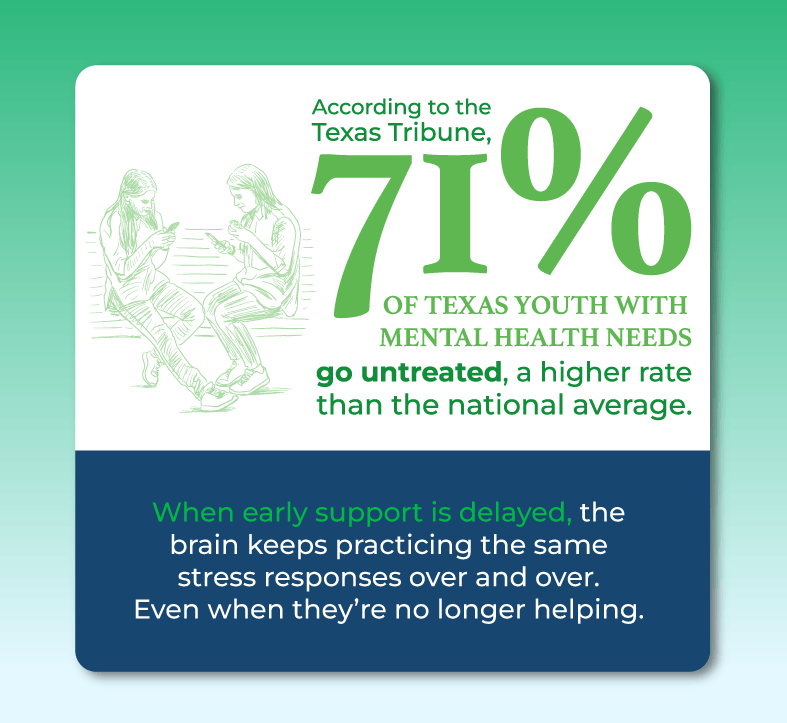
According to the Texas Tribune, 71% of Texas youth with mental health needs go untreated, a higher rate than the national average. When early support is delayed, the brain keeps practicing the same stress responses over and over. Even when they’re no longer helping.
This blog answers one simple question:
How do teens’ brains actually change, and how can families support healthier patterns instead of reinforcing the survival mode?
At Bricolage Behavioral Health, everything we do is built around this idea. We don’t just treat symptoms. We help teens practice new ways of thinking, responding, and living … because practice is what changes the brain.
Adolescence is not just a phase of emotional change.
It is also a period of structural brain remodeling.
During these years, the brain is actively reshaping itself in response to experience.
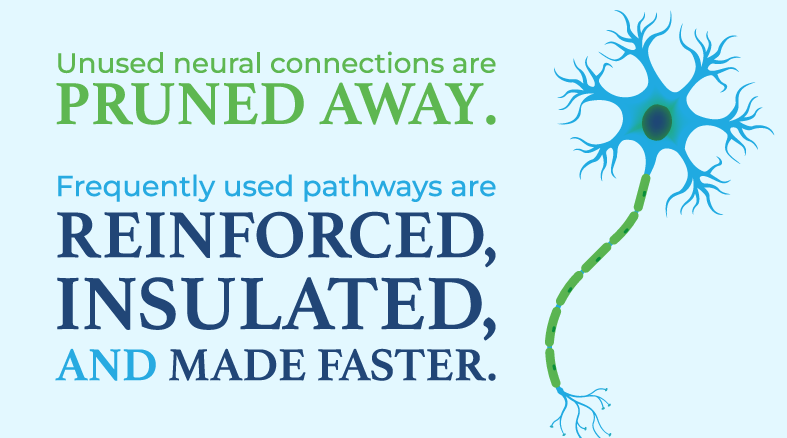
Unused neural connections are pruned away.
Frequently used pathways are reinforced, insulated, and made faster.
This process helps the brain become more efficient, but it also means that whatever a teen practices most often becomes their default response.
This is why stress, avoidance, and emotional shutdown can start to feel like an automatic response. It’s also why healing is possible. When the brain is given repeated opportunities to regulate, reflect, connect, and recover, it learns new patterns just as reliably as it learned the old ones.
Here’s what that looks like in practice:
| What the Brain Learns | Long-Term Impact | |
|---|---|---|
| Chronic stress or chaos | Hypervigilance, threat detection | Anxiety, emotional reactivity |
| Avoidance or withdrawal | Escape as protection | Social anxiety, isolation |
| Skill practice and regulation | Flexibility and self-control | Emotional resilience |
| Safe connection | Trust and co-regulation | Improved relationships |
Nothing about this process is permanent…but it is directional.
The brain becomes what it practices, for better or worse.
The good news? Practice can train the brain.
Teen brains are not fragile.
They are highly plastic.
During adolescence, the brain is in a peak period of learning from experience. Neural circuits related to emotion, reward, and threat detection are especially active – while the regions responsible for impulse control and long-term planning are still under construction. This doesn’t make teens irrational, it makes them exceptionally responsive to what happens around them.
From a neuroplasticity standpoint, environment is not background noise.
It is instruction.
Every repeated experience sends signals to the developing brain about what is safe, what is risky, what is rewarding, and what requires defense. Over time, these signals shape default responses … often without any conscious awareness.
This is why the environment matters so much more than motivation or insight alone. The brain doesn’t wait for understanding before it learns. It learns from patterns.
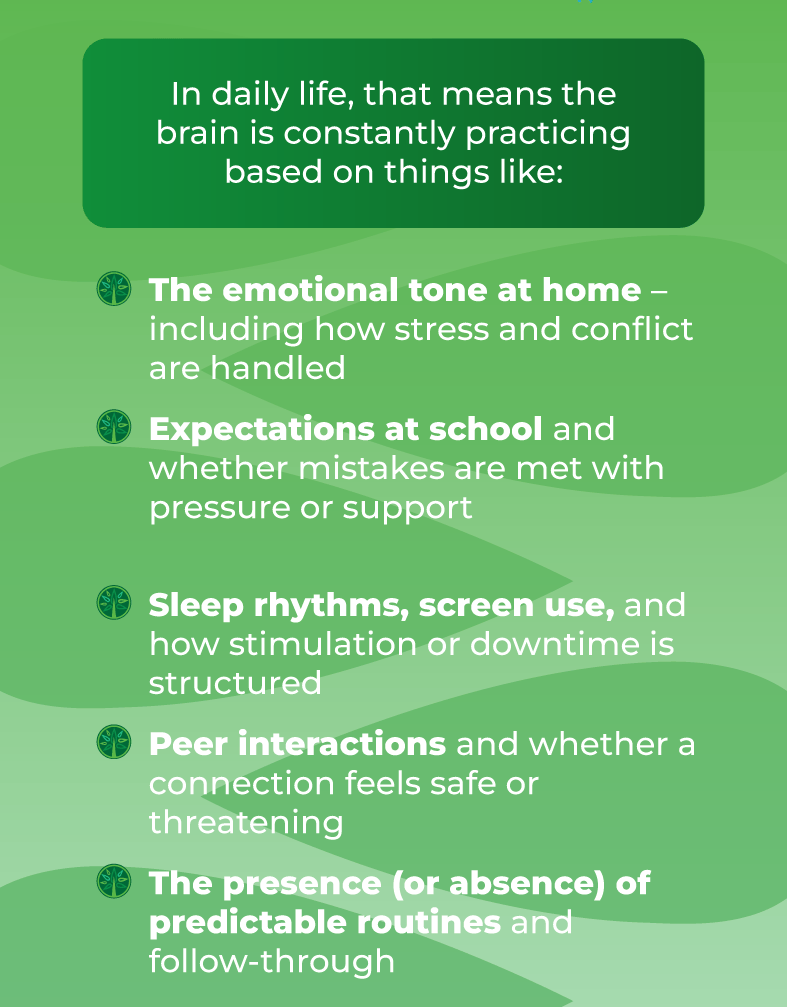
In daily life, that means the brain is constantly practicing based on things like:
When the inputs your teen receives are chaotic, inconsistent, and overwhelming, the brain adapts by staying alert, guarded, and reactive – but when they are predictable, supportive, and skill-focused, the brain can start to lower its defenses.
That shift matters.
As their environment becomes safer and more consistent again, the nervous system can spend less energy on survival and more on learning. Emotional regulation improves. Flexibility increases. New coping strategies actually stick. Not because a teen is trying harder, but because the brain finally has the conditions it needs to change.
Neuroplasticity does not respond to pressure.
It responds to repeated safety and structure.
Motivation comes and goes … especially for a teen whose nervous systems is already overloaded.
When anxiety, depression, or chronic stress are present, the nervous system often operates in survival mode. In that state, motivation is unreliable – not because a teen doesn’t care, but because the brain is prioritizing protection over productivity.
Routines step in where motivation drops out.
From a neuroplasticity perspective, routines can reduce uncertainty, lower the cognitive load, and create predictable pathways that the brain can follow without constant decision-making. Each repetition reinforces a sense of safety and control, allowing regulation pathways to strengthen over time.
This is why routines are not about discipline or compliance.
They are about giving the brain something stable to practice.
Motivation may spark change occasionally, but routine is what makes that change sustainable – because the brain learns through repetition, not intention.
Insight alone does not rewire the brain.
A teen can understand why something is happening and still feel stuck responding in the same way. This is because learning happens through repetition, not realization. Every time a response is practiced – whether it’s avoidance, impulsivity, emotional shutdown, or positive regulation – the associated neural pathway becomes stronger.
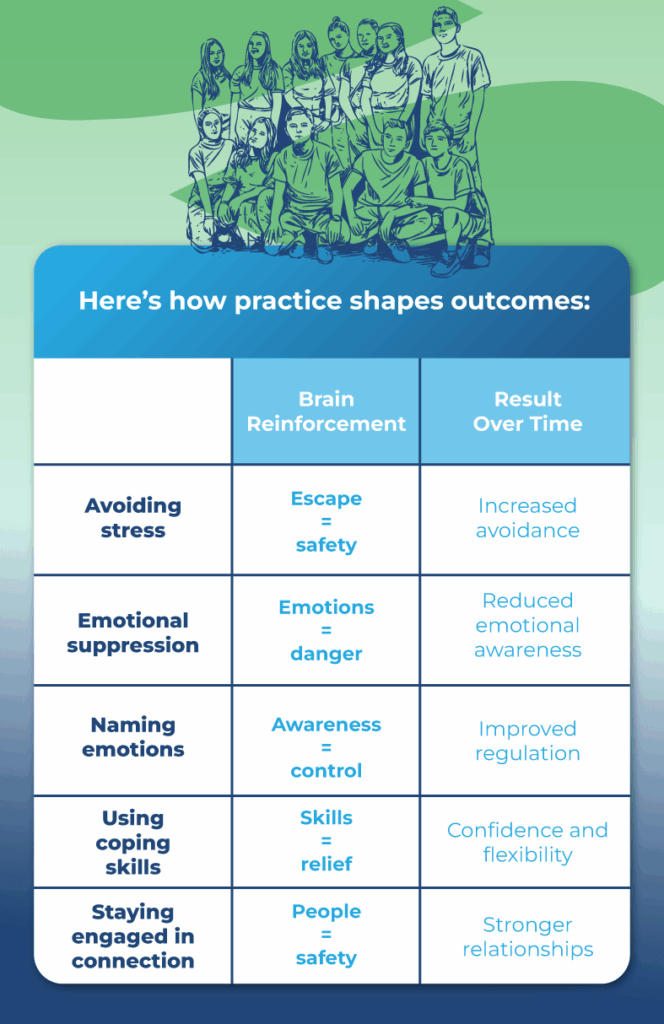
Here’s how practice shapes outcomes:
| Brain Reinforcement | Result Over Time | |
|---|---|---|
| Avoiding stress | Escape = safety | Increased avoidance |
| Emotional suppression | Emotions = danger | Reduced emotional awareness |
| Naming emotions | Awareness = control | Improved regulation |
| Using coping skills | Skills = relief | Confidence and flexibility |
| Staying engaged in connection | People = safety | Stronger relationships |
Consistency matters more than intensity because the brain learns through frequency, not force.
Small and repeated efforts create more change than occasional breakthroughs. This is why sustainable healing looks gradual, and why it has the power to last.
Hobbies often get dismissed as optional, indulgent, or something to just “come back to later.”
From a neuroplasticity perspective, though, they are anything but extras.
When teens engage in activities that hold their attention without pressure – like creative projects, movement, building, music, gaming with structure, or shared interests – the brain experiences something critical … regulated focus paired with reward.
These moments teach the brain:
That sense of capability is foundational to healing.
More importantly, hobbies give teens a place to practice skills without the emotional weight that is attached to school, relationships, or expectations. They create low-stakes environments where regulation, persistence, and enjoyment can coexist.
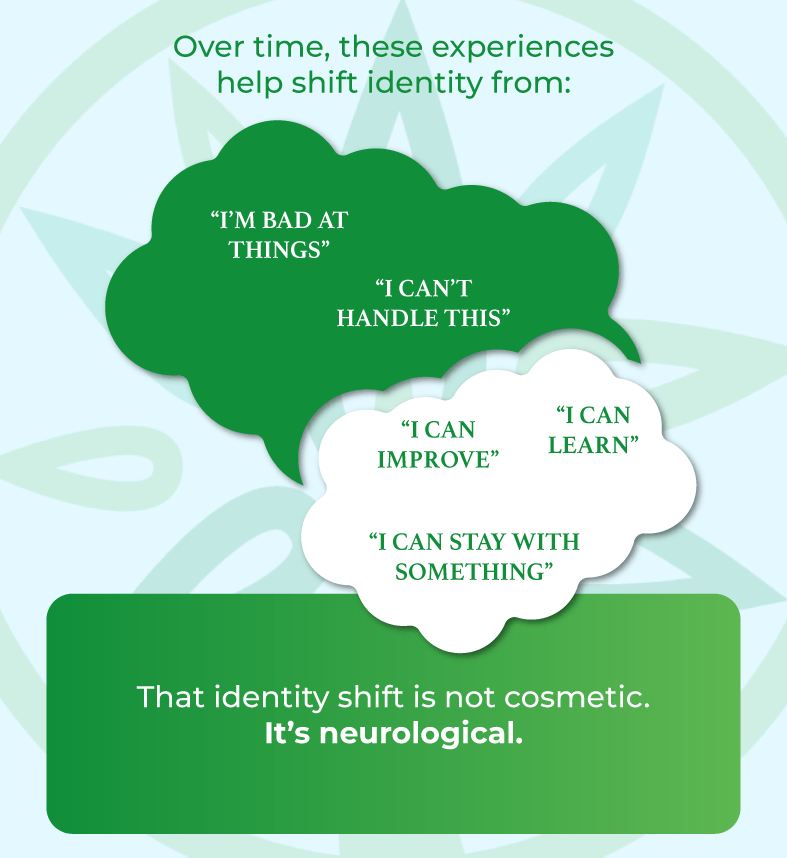
Over time, these experiences help shift identity from“I’m bad at things” or “I can’t handle this” to “I can learn,” “I can improve,” and “I can stay with something.”
That identity shift is not cosmetic. It’s neurological.
Effort without tools does not build confidence.
It builds frustration.
A developing brain needs guidance, modeling, and repetition to create new pathways. When teens are told to just “try harder” without being taught how, the brain interprets failure as proof that something is wrong with them. Not that they need support.
Skills are different.
Skills give the brain something concrete to practice. And when teens get to use those skills in real situations with support, the brain begins to replace survival responses with regulation.
This is how coping replaces crisis.
And how habits begin to replace coping.
When families say their teen feels “stuck,” they’re rarely talking about a lack of effort. More often, they’re describing a cycle that just keeps repeating.
The same reactions, the same shutdowns, the same arguments, the same avoidance – even when everyone is trying their best.
From a neuroplasticity standpoint, this makes sense.
The brain doesn’t get unstuck through insight alone.
It changes when the environment, expectations, and daily practice change together.
That’s why treatment at Bricolage is designed to interrupt patterns – not just talk about them.
Our programs are structured to give teens repeated opportunities to practice regulation, engagement, and problem-solving in real time, with support built into every layer of care.
Below is how our levels of care work to help teens move out of survival mode and into growth.
| What It Looks Like in Practice | How It Helps Teens Feel Less “Stuck” | |
|---|---|---|
| Partial Hospitalization Program (PHP) | Full-day therapeutic programming, five days a week, with academic support, whole-group therapy, family involvement, and psychiatric oversight | Creates a consistent structure when symptoms interfere with daily functioning, reduces overwhelm, and helps the brain relearn safety through predictable routines |
| Intensive Outpatient Program (IOP) | Several hours of therapy multiple days per week, allowing teens to stay connected to school and home while receiving structured support | Supports gradual reintegration into daily life while maintaining skill practice, accountability, and emotional regulation |
| Whole-Group Therapy Model | Active participation through focus tasks, pair work, role play, and collaborative problem-solving | Keeps the brain engaged instead of passive, reinforcing learning through repetition rather than observation |
| Family-Involved Treatment | Regular communication, family sessions, and guidance for applying skills at home | Aligns the home environment with treatment goals so progress doesn’t stall outside of sessions |
| Medication-Independence as Psychiatric Support | Thoughtful assessment and monitoring when appropriate, without over-reliance | Supports stabilization while skills and routines do the long-term rewiring |
Getting unstuck is not about pushing harder. It’s about practicing differently.
When teens are placed in environments that are structured but not rigid, supportive without being enabling, and challenging without being overwhelming, the brain has space to change.
Repetition builds confidence. Engagement builds agency. Consistency builds trust — both internally and with others.
Neuroplasticity explains why teens can change.
The right environment helps make that change last.
At Bricolage Behavioral Health, treatment is built around repeated practice – the kind of practice that helps the adolescent brain form healthier patterns over time. Through whole-group therapy, skills development, and family involvement, teens are supported in learning how to regulate, connect, and respond differently to stress.
Change doesn’t come from insight alone. It comes from consistent experience, practiced in the right setting.

Call 469-968-5700 to learn more about treatment at Bricolage Behavioral Health.
Bricolage Behavioral Health is strength-based, skills-based, evidence-based, and medication-light. We empower your child or teen to develop the skills they need to take control of their mental health with effective, science-backed therapy.
At Bricolage Behavioral Health we believe that whole family healing affords your child the best chance for long term mental health and can put your loved ones on the path to a healthier, happier life.
Bricolage Behavioral Health
3204 Long Prairie Road
Suite A
Flower Mound, TX 75022
Mon - Fri: 8:30 AM–9:00 PM
Sat & Sun: 9:00 AM–5:00 PM