Around 19% of teens will self-harm at some point in their lives, with as many as 7% of them injuring themselves five times or more in one year. Texas teens are no different.

Your child is far more than that statistic. They are a precious, growing young person managing extreme emotions and adjusting rapidly to the size of the world around them. Teens naturally search for ways to cope with the stress of school, hormones, their approaching adulthood, and everything that comes with it. Unfortunately, some teens turn that stress inward and harm themselves as a way to try to manage it.
Thankfully, it’s possible to break the habit of self-harm. It takes work, but finding a healthier way to manage painful emotions is worth it, and Bricolage Behavioral Health can help.

Self-harm comes in many forms for many different reasons, but it’s all related to a teen’s inability to cope with emotional stress safely. The physical pain of self-harm can feel temporarily cathartic to teens who engage in this behavior, and it might provide relief, but not for long.
Self-harm isn’t so unlike a substance use disorder or any other type of addiction. Self-injury activates many of the same brain mechanisms as some substances, including motivation and reward systems. If you apply the DSM-5 criteria for a substance use disorder with self-harm as the “substance” of choice, you’ll find they likely could receive a diagnosis. Self-harm also comes with cravings, a loss of control, and physical and psychological consequences. Many self-harming teens will isolate themselves and may engage in more and more self-injury to feel the “relief” they’re searching for.
The most well-known form of self-harm is cutting, especially on the wrists or forearms. Research suggests that at least 55% of self-harming teens resort to cutting, but that means 45% might use another means to injure themselves.
These are a few behaviors that also qualify as self-harm:
Poisoning was the preferred method of self-harm for 26% of teens in the study above, with hitting themselves coming in third at about 8%, though it’s worth noting that not every type of self-harm on this list was represented in the study.
It’s also common for teens to use multiple methods of self-harm. 76% of surveyed teens in one Texas study reported self-harming in more than one way.
How we treat self-harm depends on each child. Often, self-harm is part of a more complex mental health condition, such as depression or borderline personality disorder (BPD).
Ultimately, the diagnosis isn’t that important to us at Bricolage. We want to focus on why the child self-harms and help them heal from that larger cause. Once we do that and teach them healthier coping mechanisms, self-harm won’t feel like the same solution it was before treatment.
No matter your child’s motives or larger diagnosis, they’ll participate in cognitive behavioral therapy (CBT) and Bricolage’s unique whole-group therapy. We can introduce a host of other therapy modalities as needed, too.
CBT focuses on changing thought and behavioral patterns, and is a significant part of treatment for self-harm at Bricolage. We want to change our kiddos’ thought processes that lead them to believe self-harm is an appropriate coping mechanism, and teach them better ways to manage their emotions and stress.
For example, when a teen typically fixates on negative thoughts that cause them to spiral into self-harming behavior to find “relief” from those thoughts, CBT teaches teens to change those thought processes. In CBT, a thought like, 'I'm worthless and don't deserve good things,' isn't simply replaced with a positive affirmation, although that's one technique. Rather, the thought process itself is disrupted. CBT teaches teens how to shift negative, irrational thoughts into more productive ones that promote safer and healthier behavior.
Bricolage has a unique and engaging whole-group therapy. Most group therapy happens in a round-robin format, where kids and the therapist sit in a circle, with each teen talking to the therapist individually and rarely acknowledging each other. This leads to a lot of boredom and wasted time that could be spent with everyone actively engaged!
In our therapy, we have group discussions that involve everyone, and more importantly, lots of chances for teens to interact and practice their skills together. They’ll gain the tools they need to break dysfunctional behavioral patterns and discover how to communicate with their peers in the process.
Many programs focus only on teaching some of the CBT tools mentioned above. But this isn’t enough. Your teen has to practice to proficiency to be successful in their recovery. Their default coping mechanism has become self-harm. In order to change that behavior, they need more than someone telling them how or what to change. We need the better coping mechanisms to become second nature to them by the time they leave our program.
They’ll also build relationships and learn to support one another once they complete their treatment with Bricolage, setting them up for long-term success.
Teens have a lot of different motives for self-harming, and figuring out the source is one of the most important components of treatment at Bricolage. Here are some common reasons we see:
Reasons for self-harm frequently go even deeper than this, so we need to ask more questions. What is causing the emotional pain that they’re turning to self-harm to manage? Are there strategies we can teach them to regain control of their life? What about ways to communicate their feelings with others in a productive way?
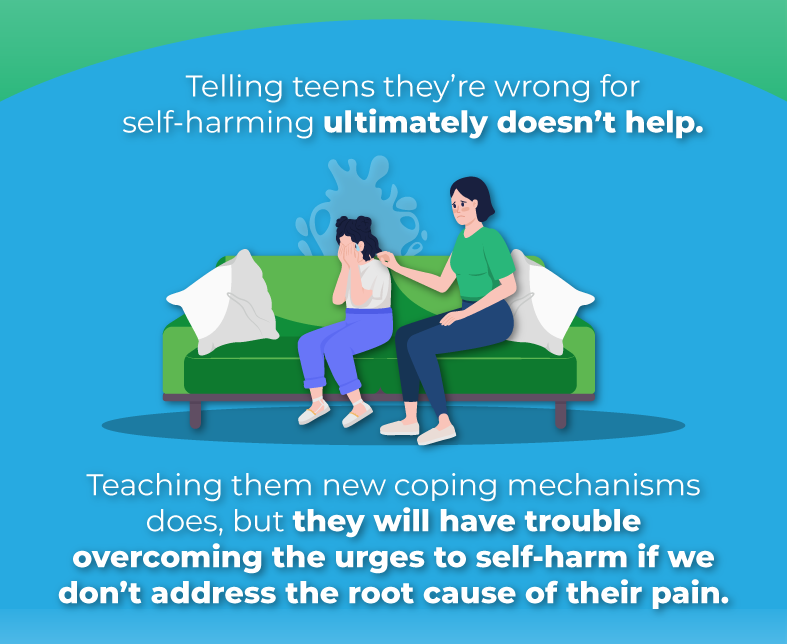
Other mental health concerns, like depression, borderline personality disorder, obsessive-compulsive disorder, and others, often accompany self-harm. Unresolved trauma is also a common factor. Telling teens they’re wrong for self-harming ultimately doesn’t help. Teaching them new coping mechanisms does, but they will have trouble overcoming the urges to self-harm if we don’t address the root cause of their pain.
Whether it’s bullying, poor self-esteem, trauma, abuse, or something else altogether, Bricolage can help your child heal and turn away from self-harm.
The answer to this is multi-faceted. It certainly can contribute to self-harm – it just depends on how your child is using social media.
Some studies have found that teens who spend more time on social media have a higher risk of self-harm. This doesn’t mean social media causes self-harm – there’s just a pattern worth looking into further.
One key component of the relationship between social media and self-harm is the “contagion effect.” This is when seeing or hearing about a certain behavior makes it “contagious,” and self-harm is not immune to this phenomenon. Studies have shown that the more teens are exposed to self-harm-related content, the more likely they are to self-harm. Over 80% of youth see self-harm or suicide-related content online at some point in their lives. This can be dangerous, especially if the child is exposed to the content at an early age. It can pique curiosity. While self-harming once doesn’t mean it will develop into a habit, all repeated self-injury starts with that first time.
Teens also have the freedom to seek out self-harm-related content and communities online, where they might even be encouraged to continue hurting themselves. Seeing images of someone’s self-harm, such as slit wrists or cutting scars, can trigger the urge to self-harm in a teen managing this behavior. Teens engaging in disordered eating as their form of self-harm can also easily find people online to encourage them to eat less, or offer tips on how to better hide their condition. Teens who experience cyberbullying are also significantly more likely to engage in self-harm than teens who don’t.
One of the most popular platforms among teenagers is TikTok, and self-harm content on the website isn’t uncommon. TikTok’s algorithm rapidly shifts based on the videos teens watch and how long they watch each one. If they engage with mental health or self-harm-related content, it doesn’t take long for more and more related videos to pop up on their “For You” page. Explicit imagery of self-harm is rare, but discussion of it isn’t, and some creators on the platform romanticize self-injury. There are also communities on TikTok based around self-harm, normalizing the behavior.
TikTok tries to moderate this content, and even redirects searches for it to mental health resources, but community members typically use coded language to avoid the platform’s filters. Self-harm is frequently shortened to “SH,” and censored as “$H” or “selfh@rm.” Using numbers, periods, symbols, or misspelled words is a common strategy to avoid moderation.
Just as social media comes with dangers, it can also come with benefits. Teens can use social media to connect with friends and family from a distance, finding valuable support. They can also access mental health resources online that help them manage their emotions more safely.
The key is keeping an open dialogue about social media with your child. Regularly check in with them on what they’ve been up to online, and pay attention if they start getting defensive or secretive. If they do, it might warrant a more serious conversation about how they spend their time online. Imposing limits on social media or screen time might be helpful, too.

Teens often hide self-harm, and even if they don’t, it can be hard to recognize. It’s important to identify these signs of self-harm:
Some of these signs can be unrelated to self-harm, but if multiple on this list apply to your child, you should start a conversation and consider seeking professional help for them.
If you find out your child is self-harming, your initial reaction is really important. It’s an alarming and scary discovery; your natural response might be to panic or make accusations. That does significantly more harm than good.
If your child is self-harming, they likely know the behavior isn’t acceptable to other people. If they’re telling you themselves, they’re making the difficult decision to trust you with something you might judge them for. Remember that self-harm is the physical manifestation of some kind of emotional pain. That means telling your child they’re wrong for harming themselves isn’t helpful. Instead, talk to them calmly and with compassion. Ask what’s going on in their life to make them want to hurt themselves with genuine concern, not in a tone that they can interpret as you thinking they’re not managing enough stress to justify their self-harm.
Of course, nothing justifies self-harm, but teens engaging in it think so much about it that they’re able to convince themselves it’s okay, even necessary. Listen to anything your teen tells you and try to understand where they’re coming from. You can gently correct their logic, but make sure it doesn’t become an argument.
There are also some strategies you can try at home. Try:
Obviously, also remove anything from their room or the bathroom your child might use to self-harm. However, most teens will find a way to do what they want. Those who self-harm may cut themselves with their own nails or even bang their head against something. So the best way to help your teen stop self-harming is to engage some of the strategies above or seek professional help.
Once self-harm has started, the issues your teen is struggling with are often deep-rooted. Once-a-week counseling is not going to be enough to address those feelings and behaviors. More importantly, once-a-week therapy won’t be enough time to practice new coping skills to proficiency. Once self-harm has started, intensive outpatient (IOP) or day treatment (PHP) are often the most appropriate levels of care.

If your child is self-harming, it’s scary and confusing. You probably have a lot of questions, but your top priority is inevitably your child’s safety and well-being. Help and answers are available. Reach out to experts on youth mental health like us at Bricolage Behavioral Health. Healing will be hard work, but it will be worth it. We’ll walk with you and your child every step of the way.
Bricolage Behavioral Health provides mental health support for youth in Texas. While we believe medication is helpful, we also know medication alone isn’t enough for a child to heal comprehensively. Healing takes both group and individual therapy, hard work, and practicing new skills. That’s exactly what we do at Bricolage – and while medication can be a great tool in the process, it’s not the final answer. We’ll work with your child to determine their personal goals and obstacles, and equip them with the skills and strategies they need to thrive. Ready to get started? Call 469-968-5700 today.

Bricolage Behavioral Health is strength-based, skills-based, evidence-based, and medication-light. We empower clients to develop the skills they need to take control of their mental health with effective, science-backed therapy.
At Bricolage Behavioral Health we believe that whole family healing affords your child the best chance for long term mental health and can put your loved ones on the path to a healthier, happier life.
Bricolage Behavioral Health
3204 Long Prairie Road
Suite A
Flower Mound, TX 75022
Mon - Fri: 8:30 AM–9:00 PM
Sat & Sun: 9:00 AM–5:00 PM