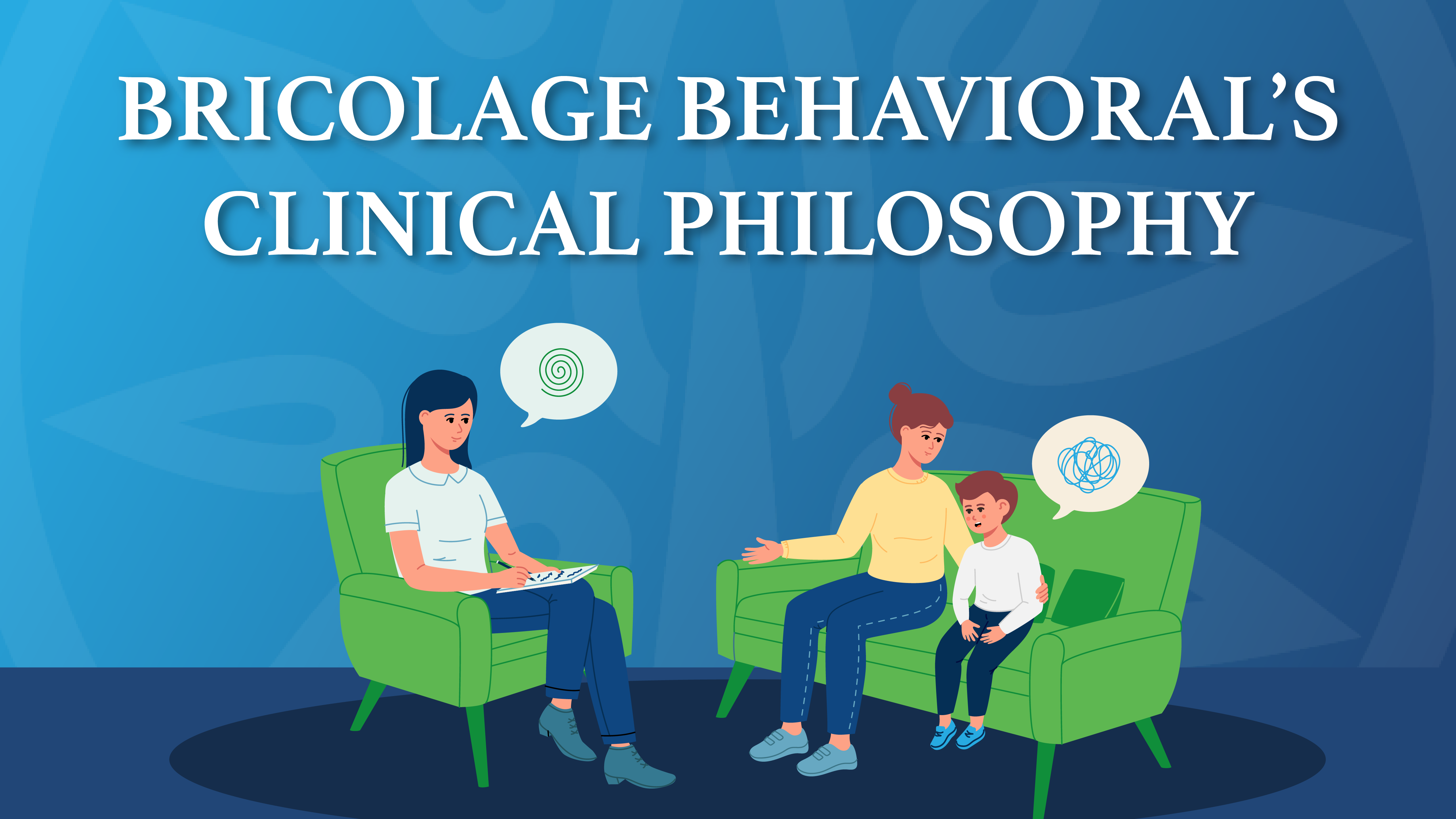
Bricolage’s therapeutic programming is unique in the world of teen therapy in that it is designed to facilitate self-development and real-world problem-solving skills in order for children and teens to find recovery from their mental health challenges. Children and teens in our program are empowered to overcome difficulties such as anxiety, depression, school avoidance, suicidal ideation, self-harm, screen addiction, substance use disorders, and so many of the other problems that plague our youth today.
Despite occasional pop culture beliefs to the contrary, sustained healing and recovery from mental health concerns is absolutely possible for anyone, whether that’s a diagnosis of depression or schizophrenia. This belief in the ability to fully help those in our program heal is an essential feature of our approach that sets us apart from other programs. By taking a strength-based, life skills-oriented, and evidence-based approach to therapy, we are able to help our children and teens reverse any negative course they may be on and, instead, find recovery and achieve success within both personal and family goals.
Another element of our program that sets us apart from every other program in the DFW area is our whole-group engagement approach to treatment. Most child and teen therapy programs practice traditional round-robin talk therapy. In this modality, the therapist talks to each child one at a time within the group setting while the others merely listen. This is not an engaging method for children and teens and is not as effective as whole-group engagement, where each child or teen is actively participating in the group through tailored therapeutic techniques such as focus tasks, pair work, project-based work, and role play.
For progress to be made, children and teens must be motivated to engage in the often difficult work of therapy. In short, bored kids don’t make progress. This is why, at Bricolage, we place significant emphasis on buy-in, self-directed goal setting, and engaging session facilitation.
More than the standard chat-based processing found in most programs, our therapists are trained to help our children and teens build the real-world skills they need to overcome their challenges and succeed in the world outside of the four walls of therapy.
With us, your son or daughter will join a group of peers with similar concerns, bond, overcome challenges together, learn from each other, and, most important of all, find healing. Change isn’t always easy, but together, we will help your child or teen develop the skills and confidence necessary to have a positive and happy life. In the world of behavioral health, most children are assigned a diagnostic label such as depression, anxiety, OCD, etc. While these are necessary for insurance billing purposes, they lack explanatory power that allows one to individualize treatment programming.
There is ALWAYS a reason based on the child’s life experience as to WHY they are depressed, anxious, unfocused, etc. Maybe they’ve experienced trauma in their lives, maybe they lack the tools and skills necessary to feel comfortable in social settings, maybe familial bonds are not as strong as they need, maybe they don’t know how to handle failure or stress, or maybe they lost someone close to them. Here at Bricolage, we identify the underlying causal factors driving the diagnosis. This functional approach empowers our kids to solve the very real problems in their lives rather than fixate on a label with little explanatory power.
We involve our families in this process as well through regular communication and family sessions at the day treatment (partial hospitalization) level of care. No man is an island, and our children and teens certainly aren’t either. They will need ongoing support from caring family members such as yourself, and we aim to equip families with the tools to continue to support their son or daughter long past the completion of treatment with us.
We welcome you to Bricolage Behavioral. We welcome you to a new and better way of engaging in treatment. We welcome you to help your son or daughter find healing that can last a lifetime.
Therapy, particularly group therapy, delivered at Bricolage, is unique in the country and potentially the world in that we engage in whole-group facilitation. Unlike the majority of programs, which rely on round-robin style interactions with one patient speaking with the therapist while all others listen passively (or, in many cases, do not listen at all), we employ techniques that ensure our kids’ active engagement throughout the entirety of the group.
The first step in therapy is positive rapport and engagement. Attention is a prerequisite for learning and behavior change. For this reason, engagement techniques are central to our therapeutic approach. These include pair and small group work, project-based activities, and whole-group facilitation.
A key component of success in treatment is helping your son or daughter achieve their personal goals related to entering our program. It can be tempting to impose our own goals on our kids, especially when we may have some wisdom and experience they are currently lacking, which would be likely to help them.
A good example is substance use. Many teens will come in with recreational substance use as a habit, sometimes excessive substance use. It is tempting for the therapist to set reduction or elimination of substance use as a goal. However, upon entering the program, the teen likely has no interest or intention of reducing or stopping. For them, their goal may be to do better in school, make friends, or achieve a better relationship with their parents.
In this situation, it is our job at Bricolage to help the teen achieve their goal of, let’s say, doing better in school. Bringing our wisdom and experience to the fore, we can and will certainly explore with the teen how their substance use is potentially negatively impacting their stated goal of doing better in school. However, our goal as a team is to help the teen do better in school. The exploration of substance use is secondary and must be explored in collaboration with the teen in order to help them achieve their goals, not as an external goal imposed on them by us. By collaborating with your son or daughter to discuss and explore how substance use is negatively impacting their own stated goals, we can build the internal motivation for change that externally imposed goals often fail to achieve.
All of our kids are good at something. Maybe they get along well with others, make people laugh, are book smart, are athletic, or are natural leaders. Whatever these strengths are, we want to identify them and help them play upon their strengths to solve the problems in their lives.
This does not mean we want to ignore weaknesses or areas for improvement. Instead, we want to help your son or daughter use their strengths in order to help them build up other areas of themselves that may not be developed as of yet.
It is our job to not just talk with or to our patients about change. We must actively give them the skills to succeed in creating change. This is akin to the difference between talking about riding a bike and actually learning to ride one. Learning to ride a bike takes extensive practice; it is not something that can be learned through a single demonstration or attempt, by listening to someone talk about bike riding, or by reading books or doing worksheets on bike riding.
In the same way, we need to equip our kids with the skills they need to succeed in life. Such skills include learning from and overcoming failure, incremental goal setting, assertive communication, emotional regulation, self-care, trigger identification, restructuring negative thoughts, etc.
We think about what your son or daughter’s goals are and then what tools/skills we need to give them in order to accomplish that goal. For example, a teen with an ADHD diagnosis may constantly blurt out what he is thinking in social contexts where this is inappropriate, leading to rejection by peers or family.
In this case, our patient would need to learn a series of skills in sequential order:
We see in the example above how telling one of our kids they have ADHD provides no clear pathway for change. What does such a label do for them? How does it help them solve problems or change? It doesn’t. Instead, when we say, “One of your challenges is focus, and here are 3 ways to start improving focus,” or, “Speaking before evaluating the appropriateness of what you say is causing problems in your relationships, here’s a 3-step process we will practice to help you change that,” now that’s helpful to a kid.
In order for a behavior or thought pattern to become ingrained or the default behavior, just like we can now ride a bike without thinking about it, we have to give the patient extensive real-world practice opportunities. This means role plays, projects, or active engagement with us and their peers to create the procedural learning pathways needed for sustained change.
Most programs claim to be evidence-based, but we take it a step further to incorporate a neuroscience-based approach to care. Let us explain. There are 3 components to effective, evidence-based therapy as identified in Bruce Wampold’s comprehensive The Great Psychotherapy Debate:
As far as the research has shown, the agreed-upon philosophy of causation and mechanisms of change can be any modality — CBT, DBT, Seeking Safety, Exposure Therapy, etc. In countless meta-analyses, no modality has been shown to be any better or worse than any other.
Here at Bricolage, we go beyond evidence-based with an emphasis on science-based care. Evidence-based care is developed from research comparisons. Cognitive behavioral therapy is compared to placebo and the research tells us which one delivers a better result. This is important, but it doesn't tell us WHY cognitive behavioral therapy works better. For that, we need to understand the neuroscience as it relates to memory, mental function, emotion, and behavior.
CBT works because the patient lacks a skill needed to achieve a treatment goal. Neuroscience tells us that the brain can develop new skills given the right support and direction, so CBT is appropriate when skills are needed. Trauma is a product of the way our brains encode life-threatening memories and develop related schema. Addressing trauma requires engaging those same neural processes, which is usually a mix of DBT, CPT, and exposure therapies. This is why we say we take a science-based approach in addition to using evidence-based techniques. When we understand how the brain works, we can apply the most effective treatment.
The true key is functional skill building. Whatever modality is used, we need to equip our kids with the real-world skills that will help them solve the problems at hand.
Other components of effective healing which we incorporate into our programming:
There is no biomarker such as blood, genes, or neurochemical signatures that identify a mental health diagnosis. This is why the DSM is a categorization system based on symptomology clusters. A DSM diagnosis is simply a proxy for a clustering of symptoms and does not definitively define behaviors or mental health states.
While there still exists widespread belief among the general populace that mental health concerns are the result of faulty genes or neurochemical imbalances, such assumptions have been widely debunked in the more sophisticated scientific literature.
Various medications can act as a catalyst for behavior change but cannot, in and of themselves, create new neuropathways or self-reproducing neurochemical states. For behavior and thought pattern change to occur and for such changes to crystalize, patients must rewire neuropathways that facilitate different ways of behaving and thinking. Like a child learning to ride a bike, this can only occur through repetitive practice and reinforcement, the standard neurobiological mantra of “fire it to wire it.”
Bricolage will judiciously use medications to catalyze change with the goal of equipping children and teens with the therapeutic tools to manage their own medications or to titrate off of them, whichever is most clinically appropriate. Our ultimate goal is medication independence. This means:
By combining the above core elements, we at Bricolage provide a standard of care not found anywhere else in the DFW area. Our unique approach ensures your child progresses along their Treatment Plan and Therapy Goals to not only set them firmly on the journey to recovery but also provide them with the knowledge and skills to overcome any challenges they may face in the future.
Bricolage Behavioral Health is strength-based, skills-based, evidence-based, and medication-light. We empower clients to develop the skills they need to take control of their mental health with effective, science-backed therapy.
At Bricolage Behavioral Health we believe that whole family healing affords your child the best chance for long term mental health and can put your loved ones on the path to a healthier, happier life.
Bricolage Behavioral Health
3204 Long Prairie Road
Suite A
Flower Mound, TX 75022
Mon - Fri: 8:30 AM–9:00 PM
Sat & Sun: 9:00 AM–5:00 PM