If you’ve watched your teen melt down over something that seems small (a lost earbud, a B-minus, a text that didn’t get answered), it’s easy to think they’re being “dramatic.”
But it isn’t a performance. It’s biology. Stress is a switch that flips on the nervous system, and when it stays on day after day, it starts showing up everywhere. Stomachaches, headaches, angry blowups, shutting down, or a relentless need to be perfect are all symptoms of a dysregulated nervous system.
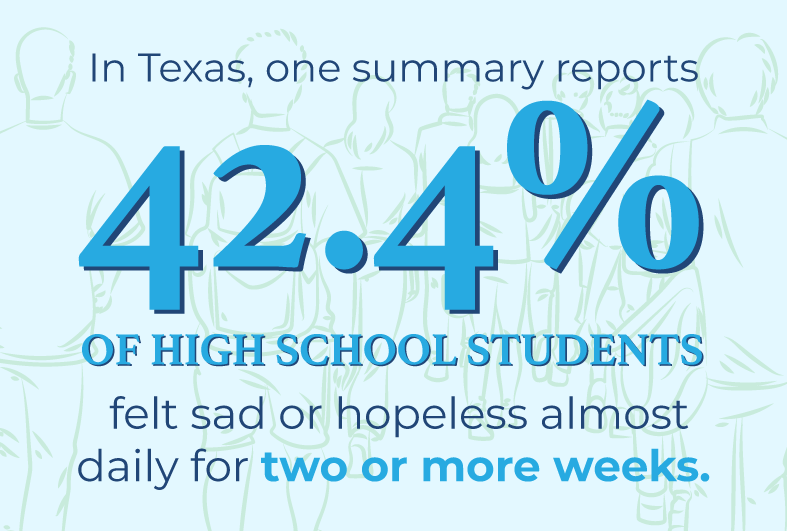
This is bigger than one bad week. In 2023, about 40% of U.S. high school students reported persistent sadness or hopelessness. In Texas, one summary reports 42.4% of high school students felt sad or hopeless almost daily for two or more weeks.
Keep reading to understand what’s driving teen stress and how you can help.
Most of the time, teens aren’t stressed because of one singular, catastrophic event. It is usually a "pileup." It is a collection of weights that eventually become too heavy to carry. When we look under the hood, we usually see a few common drivers.
For many teens, school has stopped feeling like a place to learn and started feeling like a never-ending scoreboard. Between the push for advanced placement classes, the weight of standardized testing, and the looming shadow of college admissions, the stakes feel permanent. It creates "all-or-nothing" thinking, where a teen believes that if they are not the best, they are failing.
When a child lives in this state of constant performance, their self-worth becomes tied to a GPA. This is a fragile way to live.
What you might notice:
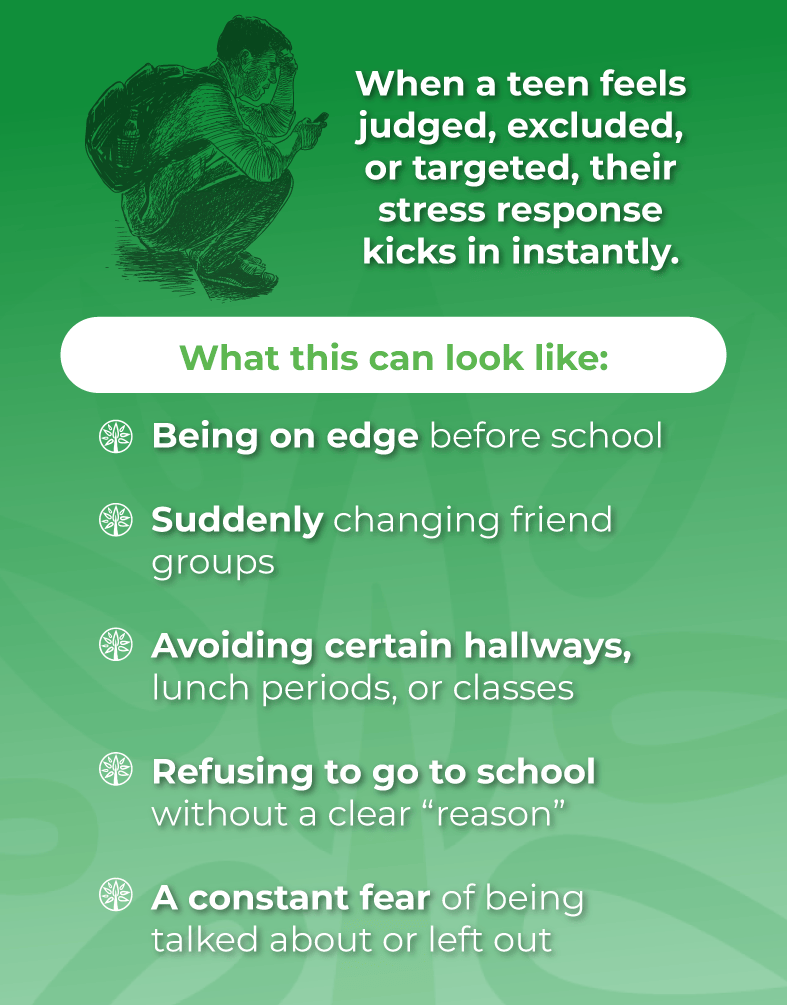
In the teenage brain, social belonging isn't just a "nice to have." It feels like a matter of survival. Evolutionarily, being excluded from the group meant danger, and that instinct is still very much alive in adolescents. When a teen feels judged, excluded, or targeted, their stress response kicks in instantly.
What this can look like:
The CDC’s 2023 results show a troubling trend with increases in students reporting being bullied at school and even missing school because they simply do not feel safe. This isn't just about "mean girls" or "schoolyard fights" anymore. It is about a constant, 24-hour cycle of social evaluation that leaves very little room for a teen to just be themselves.
Social media isn’t automatically the villain of the story, but it can crank stress up to unbearable levels. It functions as a 24/7 comparison machine. Even when a teen is sitting safely on their couch, they are bombarded with "highlight reels" of everyone else’s lives.
How it often ramps up stress:
The U.S. Surgeon General’s advisory notes that kids who spend more than three hours a day on social media face double the risk of poor mental health outcomes, including symptoms of depression and anxiety. If your teen’s mood tanks after scrolling, or if they cannot stop checking notifications, that is not a lack of self-control. That is a system getting trained to stay on high alert.
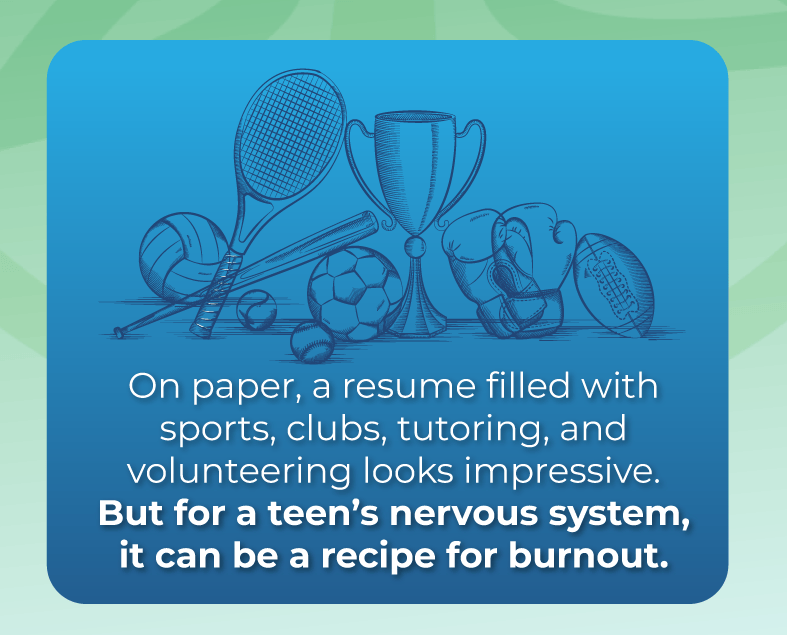
On paper, a resume filled with sports, clubs, tutoring, and volunteering looks impressive. But for a teen’s nervous system, it can be a recipe for burnout. When every hour of the day is managed and "productive," there is no time for the nervous system to discharge stress.
Why it builds stress so fast:
We often forget that teens need "nothing time." They need time to stare at a wall, listen to music, or just sit without a goal. When there is no downtime, stress doesn't evaporate. It just accumulates until the system reaches a breaking point.
Teens are like emotional sponges. They pick up on the "vibe" of the household even when adults are trying their best to keep things quiet. Whether it is financial strain, a parent’s own work stress, a divorce, grief, or chronic conflict, teens feel the shift.
| What’s happening in the background | What it can look like in a teen |
|---|---|
| Financial strain, a parent’s work stress | Becoming more irritable or picking fights to vent the pressure |
| A divorce, grief | Going numb and "disappearing" into their rooms |
| Chronic conflict | Controlling what they can, such as food, grades, or peers |
It is all just stress trying to organize itself into something manageable.
Adolescence is a season of massive, rapid transition. Their bodies are changing in ways they cannot control, and their sense of who they are is being tested daily. If a teen feels like they don’t fit the mold, or if they feel it isn't safe to be their authentic self, their internal stress baseline remains incredibly high.
Common pressure points:
Some teens aren't just "stressed." They are stuck in survival mode. Trauma, loss, instability, or ongoing conflict can keep the nervous system "on" indefinitely. This often looks like "bad behavior" such as anger, impulsivity, or shutting down. In reality, it is the brain’s way of trying to protect itself from further harm.
| What you might see | What may be happening underneath |
|---|---|
| Anger | The brain’s way of trying to protect itself from harm |
| Impulsivity | The nervous system stuck in an "on" state indefinitely |
| Shutting down | Stuck in survival mode |
| Hypervigilance | Always waiting for the next thing to go wrong |

Conditions like ADHD, OCD, anxiety, or depression act as "stress multipliers." They make everyday tasks feel significantly harder than they look from the outside. A simple assignment can feel like climbing a mountain for a teen with ADHD.
How this can snowball:
To put it simply, adolescence is stressful because teens are learning how to be adults while their brains are still building the wiring to do that well.
They’re managing more of everything at once:
At the same time, the part of the brain that helps with planning, impulse control, and emotional regulation is still developing. That creates a gap where reactions can be intense and immediate. It isn’t because they’re “bad” or “rebellious.” It’s because their system gets overwhelmed – the logical brain can’t catch up to the emotional brain fast enough.
That’s also why lectures don’t work as well as practice. If you want a teen to handle stress differently, they need support. The brain can change its connections in response to experience through a process called neuroplasticity. When a teen practices a coping skill over and over, they aren’t just learning an idea. They’re training a new physical response.
These are practical tools. They are not magic, but they work a lot better than telling someone to “just calm down.”
| Tip | Core Action | Rationale/Benefit |
|---|---|---|
| Name what’s happening | Help your teen label the feeling specifically (e.g., "test stress," "friend stress") instead of generally saying "I'm stressed." | Keeps the feeling from being vague and scary, helping the brain move the experience from the emotional center to the logical center. |
| Start with the body | Try a quick physical reset first, such as 60 seconds of slow breathing, a short walk, or splashing cold water on the face. | Lowers the intensity of the physical "fight or flight" response, bringing the thinking brain back online for problem-solving. |
| Protect sleep | Maintain a consistent wake-up time and a wind-down routine; keep the phone charging outside the bedroom. | Sleep is essential for the brain to process the emotions of the day, making every problem feel less overwhelming. |
| Shrink the task, then start | Teach the rule of making overwhelming tasks smaller (e.g., just write the first sentence of an essay). | Motivation often comes after starting, once the teen realizes the task is manageable. |
| Reduce social media intensity | Turn off notifications, remove apps from the home screen, and set specific windows for checking in. | Helps the teen take back control of their attention and reduces the constant comparison that causes stress. |
| Use connection as a coping tool | Maintain one steady connection with a grounding person (friend, coach, counselor). | Stress grows in isolation; being around safe people who don't demand anything from them is a source of relief. |
| Parents: coach more, interrogate less | Instead of rapid-fire questions, ask: "Do you want me to listen or help you solve it?" | Builds a partnership rather than a courtroom atmosphere, preventing questions from feeling like an interrogation when the teen is stressed. |
Stress is a common part of growing up, but if symptoms persist, are intense, or interfere with daily life, it is time to seek professional help. This isn’t as intimidating as it sounds. It simply means involving a mental health professional in your child’s life. Reach out if you are seeing things like:
✅Big changes in sleep patterns or constant exhaustion.
✅Frequent physical pain like stomachaches tied to stress.
✅Panic symptoms or withdrawal from family and friends.
✅School refusal or a major performance drop.
✅Any signs of self-harm or substance use.
✅Talk of hopelessness or "not wanting to be here."
If your teen may be in immediate danger, call or text 988 (the Suicide & Crisis Lifeline).
At Bricolage, we don’t treat stress like a character flaw. We treat stress as a pattern with a real cause. Then, we help teens change that pattern through active practice.
A lot of teens check out in traditional "sit and talk" therapy. Our approach is designed to keep them engaged. We use whole-group facilitation along with small-group work, so kids are actively participating rather than sitting in the back (hoping no one calls on them).
A diagnosis can be useful, but it doesn’t explain what is driving your child’s stress. We look underneath the symptoms to target the real drivers. We want to know why the system is stuck in survival mode so we can help it find a way back to safety.
We are strength-based and skills-based. That means your teen doesn’t just talk about coping. They practice these skills repeatedly. This builds new habits and supports lasting change that they can take home with them.
Some kids need medication, and some do not. We do not force a one-size-fits-all stance. Our focus is on stability and growing independence. When medication is part of care, we want teens to understand it and build the skills they will need to manage their health responsibly.
Bricolage Behavioral Health is also accredited by The Joint Commission, underscoring our commitment to the highest quality and safety standards.
If stress is taking over your teen’s life, you don’t have to wait for a full crisis to act. Getting help earlier tends to work better and prevents stress from hardening into long-term patterns.

Bricolage Behavioral Health provides mental health treatment for children and teens ages 11 to 18 in Flower Mound. Our programs include day treatment (PHP) and intensive outpatient (IOP).
To talk with our team about stress disorder treatment for your child, call 469-968-5700.
Bricolage Behavioral Health is strength-based, skills-based, evidence-based, and medication-light. We empower your child or teen to develop the skills they need to take control of their mental health with effective, science-backed therapy.
At Bricolage Behavioral Health we believe that whole family healing affords your child the best chance for long term mental health and can put your loved ones on the path to a healthier, happier life.
Bricolage Behavioral Health
3204 Long Prairie Road
Suite A
Flower Mound, TX 75022
Mon - Fri: 8:30 AM–9:00 PM
Sat & Sun: 9:00 AM–5:00 PM