We hear this all the time. When my child is told “No,” they lose it. Maybe it’s an emotional meltdown, maybe it’s anger and lashing out, maybe it’s flight and self-isolation. Whatever the case may be, many of us parents have all struggled with a child who doesn’t like to be told, “No,” “You can’t,” “We’re not going to do that,” etc.
When this is your child’s behavior, what is a parent to do? In this article, we’ll give you some tips.
The first thing to know is that this is not going to be easy. Oftentimes, when children refuse to hear “no” it is because they’ve learned over time that they can do something to get their way. Maybe it’s throwing a tantrum, maybe it’s annoying mom or dad until they give in, maybe it’s even threatening to hurt themselves.
Many parents today have grown up with techniques such as gentle parenting where we were told not to say no to our children, but, instead, come up with collaborative solutions. If they were upset, we were told to do what it took to calm them down, which often meant sitting with them and then talking about their big feelings. For some other parents, we just want to give our children the world with the best of intentions, so try to give them what they want.
What happens with these and related techniques is that our children start to believe they should get whatever they want. And, if they don’t get their way, they’ve learned that they can take certain actions, like throwing a fit, that will end with mom or dad giving in and giving them what they want.
This family dynamic has developed over years and has been in play for a long time. Changing it will not be easy. It will feel uncomfortable for mom or dad and your child will revolt against any changes because it means that, sometimes, they won’t get what they want.
Children are excellent at testing boundaries and finding weak spots. What this means is that, when you start to change the dynamic from your child always getting their way to having to accept boundaries or being told no, they are going to fight and fight. In the past, they’ve learned that mom, dad, or both have a breaking point. They just need to yell enough, get mad enough, hit enough, whatever the case may be, and their parents will eventually give in.
So when parents start to set boundaries that weren’t in place before, they will understandably assume that their parents probably still have a limit, maybe it’s just a new limit, higher than before, and they are absolutely going to try and find it, meaning their behaviors are going to get worse before they get better!
They’ll scream louder, throw longer tantrums, lash out more, attempt to isolate for longer. Whatever tactics they’ve used in the past, they’re going to push them even harder and maybe even try new ones.
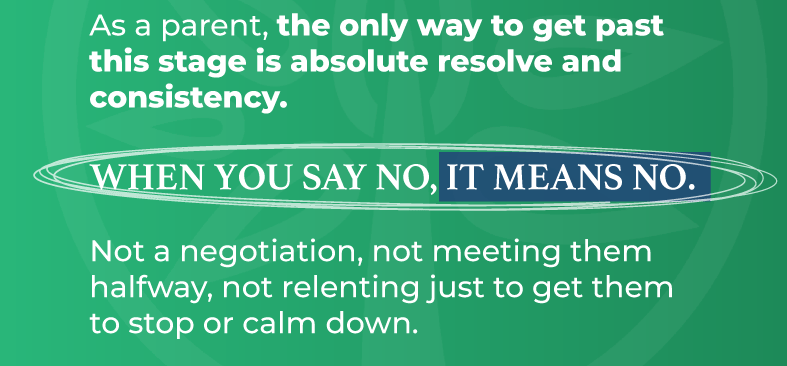
As a parent, the only way to get past this stage is absolute resolve and consistency. When you say no, it means no. Not a negotiation, not meeting them halfway, not relenting just to get them to stop or calm down.
For example, if you tell your child that they will lose phone privileges for a week due to a behavior, then you must absolutely hold to that. No opportunities to earn it back sooner or give it back early for “good behavior.” This also means thinking through consequences carefully. If you want them to have their phone because you need their having it to feel safe, knowing you can reach them and they can reach you, then losing phone privileges is not going to be a good consequence. Have different consequences in place that you can hold to.
As we’ll discuss, consequences should always be connected to the negative behavior you’re trying to steer your child away from. If taking away their phone makes the most sense, have a backup alternative that only allows calls such as the Troomi, Bark, Pinwheel phones.
Ok, so now that we understand this won’t be easier and that things will get worse before they get better, let’s look at specific techniques to help your child change this dynamic.
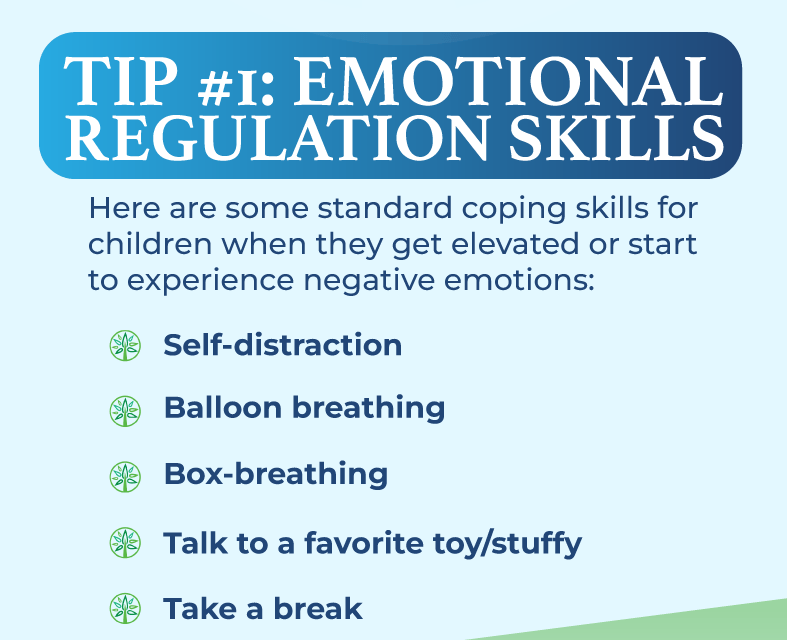
First and foremost, we need to ensure our children have the coping mechanisms in place to deal with emotions such as anger, disappointment, distress, or a subjective feeling of injustice/unfairness.
We do need to be clear here that this isn’t the only issue. Sometimes parents think that if they can simply teach their children more productive coping skills, they’ll start to use them instead. But a lack of tools in their toolbox is not the primary issue. The primary issue is that your child knows they can get their way by engaging in specific behaviors. Whether they have particular coping skills or not, they know their antics have worked in the past, so they will continue to use them as long as they see them working.
We want to teach coping skills to make sure our children have them and have tools to fall back on, but we also need to understand that this won’t resolve the underlying issue.
Here are some standard coping skills for children when they get elevated or start to experience negative emotions:
One thing we like to tell children related to using these skills is that they empower THEM to be in control of their emotions. Ask your child, “Do you want other people telling you what to do all the time?” Of course, they’ll say no. “Well then, do you want other people controlling how you feel, or do you want to be the one in control?” They’ll tell you they want to be in control.
“OK then, all these techniques help you be in control of your emotions. Rather than letting someone ‘make you angry,’ you’re not giving them that power. You’re staying in control.”
Also, talk them through what happens when they get angry or upset. Bring up specific examples rather than speaking in generalities. “Do you remember what happened last time you hit your sister?”
“Yes mom, I lost my phone for a week.”
“Did you like losing your phone?”
“No, I hated it.”
“Right, so, by maintaining control and not letting other people control YOUR emotions, you are better equipped to get an outcome that you want.”
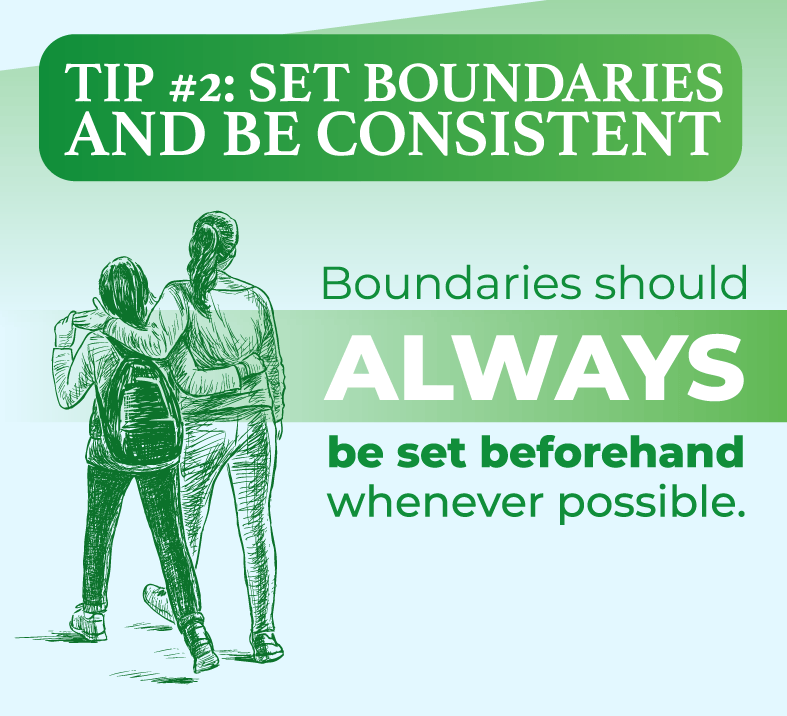
Boundaries should always be set beforehand whenever possible. For example, let’s say you want to limit screentime during the evenings after dinner. You can tell your child that they only get X amount of time. You need to let them know what the consequence will be if they go over that time before you allow them to use the screen.
This lets them know what your expectation is and what the consequence is so that there are no surprises. Then, it’s your child’s responsibility. If they go over time, they might complain or make a fuss that it’s not fair, but the truth is that they knew the rule and they broke it. They had the power and they didn’t take responsibility for their actions, so the consequence is a result of their actions. This is important to make clear to them in any conversations you may have when a consequence has to be put in place.
As discussed in the beginning, it’s absolutely critical that you hold to the consequence. Let’s say that, for going over time, the consequence was that they lose screen time for the rest of the week. Absolutely, under no circumstances should they get screen time before that week is up. They may try every tactic in the book and this will almost certainly fray any parents’ nerves, but you have to be firm and consistent.
Sometimes, as parents, consequences have to be built around what we know we can stick to. If we don’t think we’ll be able to handle our child throwing tantrums every day for a week, then we don’t want to make that the consequence last an entire week. We’re often learning and building up our own tolerances here too. Maybe we only take screen time away for one or two days because we know we can stick to our guns that long. As we get better at it, we can extend that time if appropriate.
The real key is the clear communication of the boundary beforehand. We never want to walk in and say something like, “You’ve been on that thing far too long today. Get off right now or I’m taking it away.” It could be appropriate to say, “You’ve been on that a long time today, we can do 10 more minutes and then we’re done.” However, it’s much better to set an expectation in the beginning. Sit down and have a conversation with your child. Let them know that their screen time is X amount of time on weekdays or only allowed after their homework is down. That clarity ensures a sense of fairness and puts the responsibility on them to ensure they meet expectations.
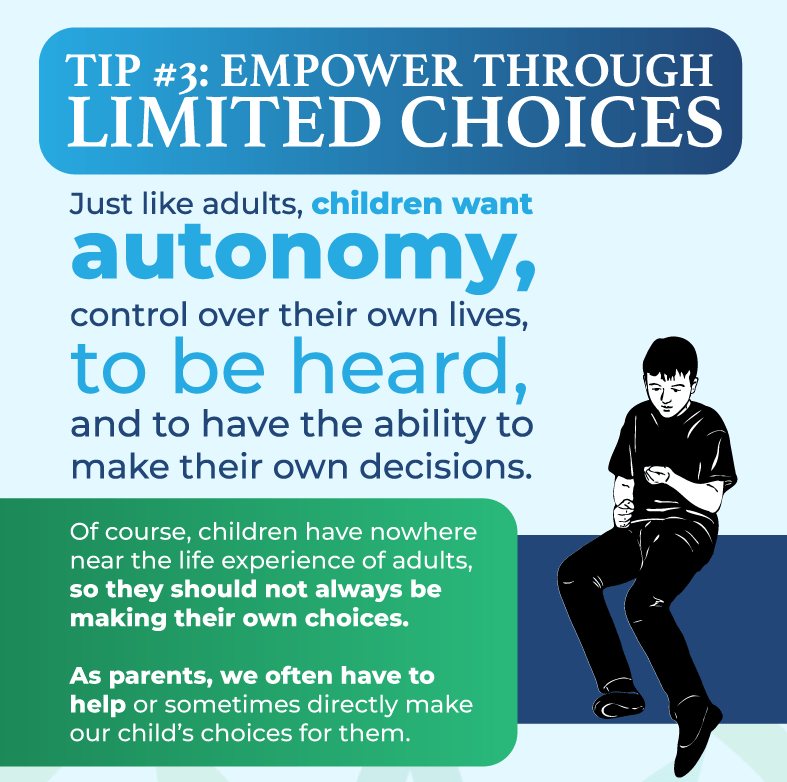
Just like adults, children want autonomy, control over their own lives, to be heard, and to have the ability to make their own decisions. Of course, children have nowhere near the life experience of adults, so they should not always be making their own choices. As parents, we often have to help or sometimes directly make our child’s choices for them. For example, if our 8-year-old said they wanted to start smoking cigarettes, we’re going to say no. If left up to their own devices, most of our children would watch YouTube and eat candy all day. It takes time and experience to learn how to balance immediate desires with long-term goals, to understand the dangers or consequences of certain behaviors. It’s our job as parents to set boundaries, help our children choose the right path, and help them avoid some of the mistakes maybe we ourselves or others have made. After all, the point in learning from history is to not just ensure we don’t repeat the same mistakes, but that we help others not repeat them as well.
So how do we balance our child’s desire for autonomy and choice with our desire to keep them safe and help them avoid known mistakes? The answer is to give them relevant choices with boundaries.
Let’s take the example of a child who wanted to smoke cigarettes. First, we want to understand why they want to smoke cigarettes.
“Because, mom, I see all the cool guys do it on TV. It must be good and I want to be cool.”
Mom could respond, “I see. Well, I’m not so sure it’s actually good. Have you read information online or watched videos on YouTube about the dangers of smoking and some of the impact it can have on your health? No? Well, why don’t you go research that for me, come back in 10 minutes, and let me know what you’ve found.”
In this way, we’re not giving a direct “no.” We’re letting our child know we hear them and that, as an adult with more experience, maybe there are some things they aren’t aware of that they need to look at first.
It’s possible, after researching, our child may still want to say they aren’t worried about it because, “Well all those people on TV did and both grandma and grandpa smoke and nothing happened to them.”
This is where we need to set boundaries as parents. “Yes, you’re right that not everyone gets sick or dies, but health problems are common and a lot of people don’t like being around smokers. Do you ever see people smoking in restaurants or stores? No? Do you know why that is? It’s because the government banned it since cigarette smoke is both bad for the health of the person smoking it and for anyone else who breathes it in around them. Would the government ban it if it were good for people?”
Of course, this may evolve into a conversation on Americans’ freedoms to choose, the money the government gets from cigarette taxes, and other topics, and that’s all OK. We’re showing our child we are hearing them and valuing their thoughts. However, ultimately, we set the boundaries.
“The government bans cigarettes in public places because it doesn’t want people to get sick and it’s not fair if one person does it, that’s their choice, but if they do it around others then they’re potentially making other people sick, which should be illegal. I also don’t want you to get sick. Do you understand why I don’t want you smoking (besides that it’s illegal for an 8-year-old to smoke!)?”
“OK, now you also said you want to look cool. I understand that. We all do. These days, all the kids are wearing (whatever the cool thing is these days). You’ve already got one and, if you help out around the house this weekend, we can go and get one more. Do you think the other kids will think you’re cool then?” Or simply discuss with your child other ways they can look and feel cool. It’s often better for them to come up with ideas and choose one rather than you choosing one (As we know, parents are inherently uncool!)
Let’s give another example. Let’s say you and your spouse want to go out to dinner that evening, but your child doesn’t want to. They want to stay home and play video games or FaceTime their friends. In this situation, we want to give them a choice, some empowerment and autonomy, but staying home is not one of those choices. Instead, we present 2 choices.
“We’re going to dinner as we don’t have anything ready to eat here. It’ll also be nice to go out as a family. We’re not staying home, but how about you pick the restaurant? We can go to the Olive Garden or Lonestar. Which one do you want to go to?”
The important elements here are:
If only it were that easy, right!? Sometimes, the simple act of giving them a choice will be enough. They’ll make a choice and everyone can move on without the theatrics. However, as many parents know, children will often try to reject either choice in order to fight for what THEY want.
“I don’t want either of those places! I want to stay home! Why can’t you just throw in a frozen pizza or I’ll microwave a hot pocket.”
The response needs to be firm and consistent. “I understand you want to stay home, but that’s not a choice. We have two choices, Olive Garden or Lonestar Steakhouse, which one do you want?”
Oftentimes, after some protestations and parents having to repeat those choices like a broken record, most kids will realize they’re not getting anywhere and then, even if grudgingly, make a choice and come along. Even if they didn’t get exactly what they wanted, by giving them some choice in the matter, they feel like their voice is valued and heard. This can prevent negative behavior.
The key here is to limit choices, usually to a set of 2 or 3. Avoid statements like, “Well choose what you’d like to do instead?” or “You choose the restaurant.” You want make it clear that you’re setting the boundaries and that, while they have choice, those choices are limited. As the parent, you’re providing what choices are acceptable for this particular situation. This moves them away from always doing what they want to collaborating with the family.
Some children will really push back though, especially if this is a technique that parents are trying for the first few times. If that’s the case, it’s likely that, in the past, the child often got their way by being stubborn, annoying, throwing tantrums, making threats, having outbursts, or engaging in other behaviors that got them their way in the past.
In those situations, then it needs to be made clear that, if the child doesn’t choose, they lose their opportunity and the parent will choose. In this scenario, tell them explicitly it’s their last chance to choose and that they have 3 seconds to give their final decision. Many children will test you at first. They’ll still refuse to choose. Then, after the 3 seconds are up, and the parent makes the choice, they’ll come back and say something like, “Well I wanted to go to the other one.” Parents can be tempted to let them get their way simply to placate them or maybe feel like they’re giving them a win. Absolutely do not do this. They need to learn that the boundaries are the boundaries and that you mean what you say. Otherwise, you’re telling your child that there is always room to negotiate or for them to engage in some kind of difficult behavior that will allow them to get their way.
Instead, the right approach is, “You had your chance to choose and you didn’t make it, so now I get to choose and we’re going to the Olive Garden. Next time I offer you a choice, remember to take it.”
Here again, it’s important to give children choices that you know YOU’LL be happy with AND to set consequences for further misbehavior. Let’s say you know, based on prior experience, that they might throw a fit in the restaurant since they’re upset. That is not a situation you want to occur as, being in a public setting, you’ll probably be forced to leave or cave in to some demand of your child’s. So you need to have a consequence in place like, “If you act up at the restaurant, then you’ll need to sit in the car and wait rather than eat with us.”
There are a range of options here. Maybe they lose other privileges if they act up in the restaurant, like losing screen time. Just be sure that these expectations are set clearly before going, not something that gets meted out as a threat once already in the restaurant and they start acting up. We always want to give our child the ability to take responsibility and make the right choice. Knowing the consequence beforehand ensures they know exactly what they’re getting themselves into.
Many parents often ask us, “What if we feel like we can’t win?” A common scenario these days is a child refusing to go to school. Most of the time, our advice here is to tell them that not going to school is not an option. Maybe they can choose a stuffy to bring or choose what they want packed in their lunch that day, so there are ways to give them appropriate choices, but not going to school should not be an option.
However, this is always easier said than done. Maybe your child physically refuses to leave the house or get in the car. If that’s the case, then there need to be other consequences. “I’m not going to physically carry you into the car. But if you refuse to get in, then you’re not allowed in your room and you get no access to any electronics in the house.” Again here, make sure this is something you can and will enforce. AND make sure to have options for what they can do.
“If you’re refusing to go to school, then you’re going to have English and Math homework to do all day.” There are thousands of websites online where a parent can print off materials or find questions for an assigned reading book.
Like before, this has to be something you know you can do. As most parents are working during the day, even if from home, they don’t have time to monitor their child 24/7. Is it feasible to ban them from all electronics? For example, can you set parental settings so the TV won’t turn on before 4pm? Can you scoop up all the devices and remotes and put in your office? Do you have the time to prep math and English homework before your day starts?
Here, the key is to ensure that your child isn’t rewarded for staying home. If we could not go to work and, instead, engage in a favorite pastime all day, of course we would want to do that too! There has to be clear consequences and we definitely don’t want our children to benefit from making poor choices. Allowing them to engage in activities they think are fun and enjoyable by skipping school is teaching them the exact opposite of what we want them to learn. If staying home is fun, then of course their school avoidance behavior will get worse over time. If any child has the choice of playing video games all day or going to math and social studies class, they’re going to choose video games.
Other options can be chores around the house. And maybe it’s not feasible for you to monitor your child all day. Again, put the responsibility on them. Tell them what needs to be done, they’ll need to prove to you that it was done. And, if not, then a consequence. Maybe they are required to still finish up the original task you assigned and then do extra chores around the house as a consequence as you know, once your work day is done, you will be able to monitor them and ensure completion.
In everything we do, we’re both empowering our child through choices and owning the responsibility for those choices, but we’re also putting in clear boundaries around what choices are available and what happens if they don’t choose from the presented options.
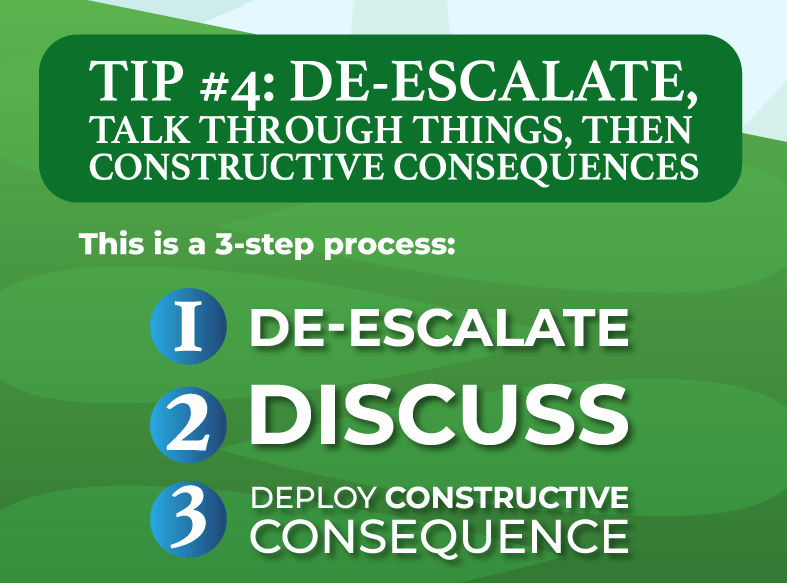
This is a 3-step process:
We always want to de-escalate first. When our children are elevated or distressed, focusing on consequences usually only makes the situation worse. If we’ve done things right and made consequences clear from the beginning, then they already know what they are and we can discuss them later after everyone has calmed down.
Let’s say our child gets really upset and punches a hole in the wall. As parents, it’s easy for us to get elevated by that behavior as well, but we need to remain calm. If we know how to engage our child to help them calm down, then we should deploy those strategies, such as reminding them to try self-distraction or balloon breathing. Or, we just may leave them to their own devices. We walk away from the situation and tell them we’ll come back when they’re ready to talk calmly. The risk here is that we may end up with a couple more holes in the wall before they calm down, but it’s probably better than further escalation or getting into a physical struggle with our child (though we do want to point out here that it’s perfectly acceptable to sit with your child and physically restrain them from harming themselves, damaging things, or hurting others. This largely depends on if you think you can do this calmly and safely). Just make sure you know how to engage in safe restraint. For some parents, no physical contact is the better choice.
Once they’ve calmed down, then it’s time to talk through everything. Why were they upset? What were some different ways they could have handled it? What alternative techniques could they have used instead of punching a hole in the wall?
In these situations, be sure to admit any mistakes you made as a parent as well. It costs us nothing to apologize or show that we’re human. Maybe we did yell or get elevated ourselves, and that happens sometimes. We want to let our children know that all of us have those feelings and, even as adults, we don’t always manage it well. But now we’re showing them that we can admit those mistakes, address situations calmly, and look for solutions to prevent future issues.
After talking through things with your child, now it’s time for the consequence. They need to take responsibility for their actions. For the example of the hole in the wall, they will need to fix it. You may need to show them how to do so or it’ll require some YouTube videos, but they need to be responsible for fixing the damage. They also need to pay for that repair. Any drywall patch, paint, and tools will need to be paid for by them. If they don’t have money or an allowance, then you can assign house chores with a dollar amount for each chore so that they pay you back over time.
We guarantee you these techniques work. Few children want to lose any saved money or spend half a day learning how to do drywall repair. Next time, they’ll punch a stuffy instead. Children are smart. They are betting on the fact that YOU will be upset by the damage and that this tactic will get them what they want because YOU will want to avoid paying for or fixing holes in the walls as a result of your child’s actions. By remaining calm and making them fix the damage, they realize this tactic isn’t working and it’s just creating problems for them. They’ll stop.
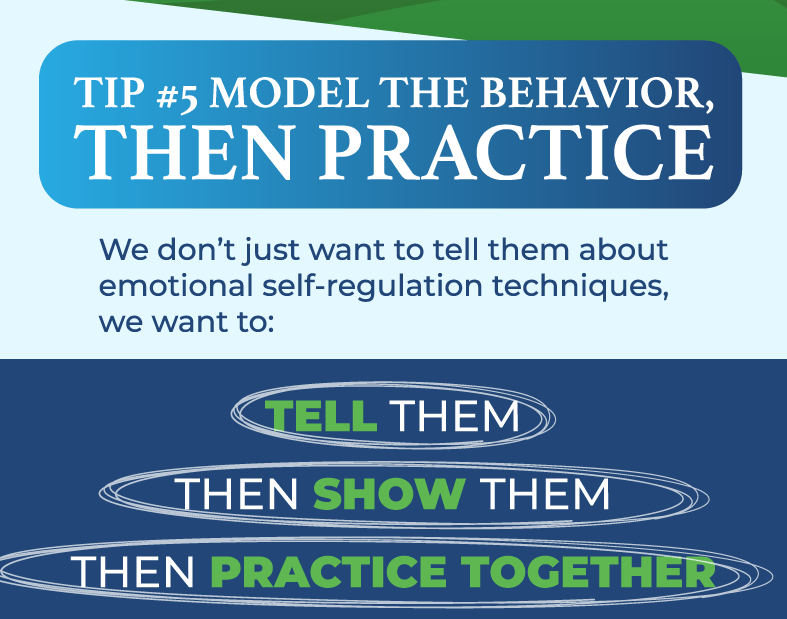
Learning doesn’t happen through knowledge absorption alone. We don’t learn to ride a bike or swim by having someone tell us how to do things. Of course, explicit instruction is the beginning of most learning processes, but then it’s all about practice.
Our children need the same. We don’t just want to tell them about emotional self-regulation techniques, we want to tell them, then show them, then practice together. The goal is that they’ve gotten enough practice that they can default to this technique and that only happens if they’ve practiced a lot.
Additionally, we need to model the behavior in context. As humans, we copy what we see. “Do as I say, not as I do” is an ineffective recipe for change. If we’re telling our children to use box breathing or take a break when getting elevated then, the next time we find ourselves in an argument with our child, we need to use those techniques ourselves and show them how it’s done.
It’s alright, this often takes practice even for parents. None of us are perfect, but the act of showing our children that it can be hard and that we’re trying as well goes a long way.
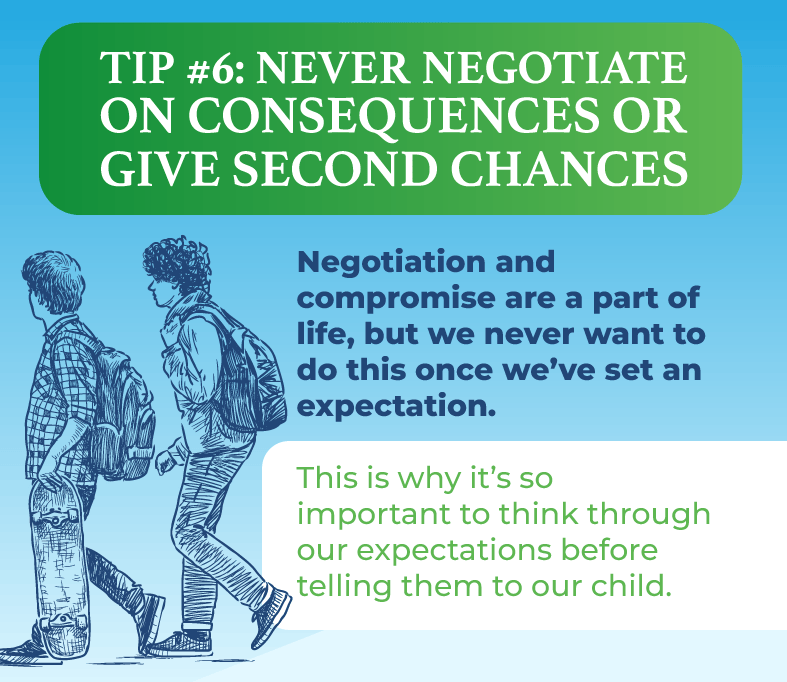
Negotiation and compromise are a part of life, but we never want to do this once we’ve set an expectation. This is why it’s so important to think through our expectations before telling them to our child. If we tell them they will lose their phone permanently for X behavior, and we know that’s not true because we need them to have it to contact them, then that’s a consequence we never want to mention.
Furthermore, we never want to negotiate after the fact. If we said they lose their phone for a week, then they lose it for a week. Not 3 days for good behavior. Not 5 days because we’re sick of them begging for it back. We said 7 and they get it back on the 8th day.
It’s important here to not engage in any kind of negotiation at all. A typical tactic of most children is to nag enough that you get annoyed and cave. Additionally, by engaging with them at all on it, you’re showing them they’ve got an opening, that this IS a negotiation, even if it’s one they’re not winning yet.
Your child will often try to draw you into arguments by saying things like, “But why can’t I have it back now?” or “It’s not fair” or “Suzi’s mom never takes her phone away.” It can be easy to get sucked into these arguments. You need to shut them down.
Don’t engage in the specific questions and use the broken record technique. “You lost it for 7 days, you’ll get it back next Monday. That’s it.”
You can also simply refuse to respond. “I told you, you’ll get it back next Monday. I’m not discussing it anymore.” Then literally ignore them. Don’t bother to answer any more questions on it. They may give up, then come back the next day and try again. “I told you yesterday, it’s not up for discussion.” Then ignore all questions on it again. We guarantee you that your child will stop pestering you within a couple of minutes at most.
If they are being extremely problematic, then simply add additional consequences. “Every time you ask me about it before Monday, I will add an extra day of time before you can get it back.” Other consequences are perfectly OK too. “If you ask again, you’ll also lose video game privileges until Monday as well.”
Many parents will make the mistake of continuing negotiations even on the follow-up consequences. They’ll say something like that their child will lose video game privileges too, then their child will push, and they’ll not follow through. Or they’ll take the video game away, but let their child take it back after complaints and protestations.
What we’re really trying to teach is that we mean what we say and that we’ll follow through. Over time, your child will stop pushing because they’ll learn that you don’t say things twice, you don’t negotiate, and you mean what you say. When we see these behaviors, it’s because, historically, your child has learned the opposite. They’ve learned that you will cave, that you will negotiate, that they can get their way by engaging in whatever behaviors get you to do what they want.
Like we said in the beginning, this change in your dynamic with your child won’t be easy. But if you follow all of the advice above, it will work. It always does. Success largely comes down to consistency and persistence.
And be easy on yourself. You might have every intention of following the advice above and sticking to your guns, but you find yourself slipping into old habits, getting elevated yourself, giving in to your child, negotiating, what-have-you. That’s OK. You’re learning too. We want progress, not perfection. As long as you’re getting better at it each day, that’s all that matters.
Parents who try out these techniques will see results. We’ve seen it with countless families. The key is to be consistent. We’re always happy to hear from families. Let us know how it goes. And if you need help, that’s OK too. We are extremely experienced at working with children struggling with depression, anxiety, compulsive behaviors, anger issues, isolation, self-harm, and suicidal thoughts. We teach children all of the above while providing structure and support in our day treatment and intensive outpatient programs. Don’t hesitate to give us a call at 469-968-5700 for a no-cost assessment or to enroll your child today.


Bricolage Behavioral Health is strength-based, skills-based, evidence-based, and medication-light. We empower your child or teen to develop the skills they need to take control of their mental health with effective, science-backed therapy.
At Bricolage Behavioral Health we believe that whole family healing affords your child the best chance for long term mental health and can put your loved ones on the path to a healthier, happier life.
Bricolage Behavioral Health
3204 Long Prairie Road
Suite A
Flower Mound, TX 75022
Mon - Fri: 8:30 AM–9:00 PM
Sat & Sun: 9:00 AM–5:00 PM