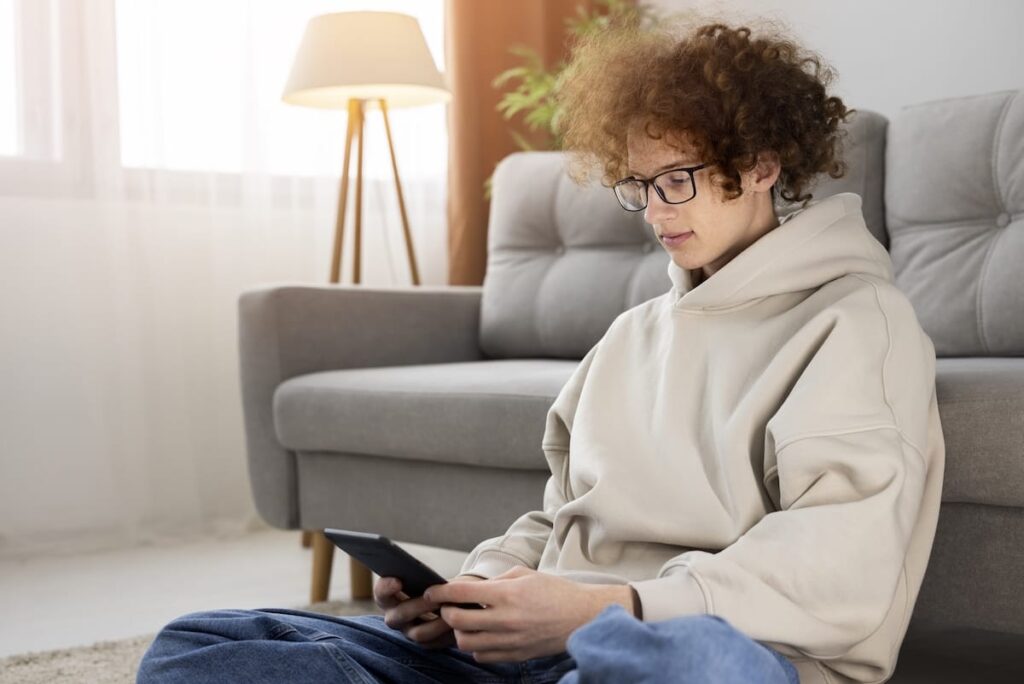
At Bricolage Behavioral Health, our electronics policy is simple. Devices are not permitted in the therapy environment. Phones and any other electronics brought to the facility will be collected at the front desk at drop off and secured for the entirety of the day. Teens return home each evening with their belongings, including any devices they brought.
This isn't a punitive policy. It's a clinical one, and its rationale is supported by a growing body of research. According to a 2024 Pew Research Center study, 48% of U.S. teens say social media has a mostly negative effect on people their age – up from 32% in 2022 – and 45% report spending too much time on it.
For teens already navigating mental health challenges, that constant feedback loop doesn't pause when they walk into treatment. We make sure it does.
Bricolage Behavioral Health is an active and engagement-driven program, and every session requires full participation from every teen in the room. That is only possible when devices aren't competing for attention.
As a general rule:
The simplest guidance for families: Leave personal electronics at home. There is no scheduled time during the program day when personal device use is permitted, and anything brought to the facility will be secured until the teen is picked up.
Teens may bring their phones to the facility, but phones are handed to the front desk at the start of the program day and locked up until the teen leaves.
Personal phone use is not permitted during program hours. Not during therapy, not during breaks, and not during the afternoon academic support block. The only circumstance under which a teen will have access to their phone during the day is a genuine emergency.
If you need to reach your teen during program hours: Call our main line at 469-968-5700, and our team will connect you with your teen in the case of a real emergency, or take a message and pass it along after group if it is not urgent.
At pick-up: Teens retrieve their phones at the end of the program day, at 12:30 PM for IOP and between 1:30 PM and 3:30 PM for PHP, depending on whether they are staying for academic support.
Whole-group engagement, the clinical model at the heart of everything we do at Bricolage, only works when every teen in the room is fully present. That means not just physically in their seat, but also mentally and emotionally available to participate, connect with peers, and practice the skills being built in real time.
Personal devices work against that in several specific ways:

Distraction and disengagement. A phone in a pocket – even a locked one – competes for attention. The anticipation of notifications, messages, and social media pulls focus away from the work happening in the room. For teens especially, whose developing brains are highly sensitive to variable-reward feedback loops, this isn't a matter of willpower. It's neurological.

Privacy and safety. Every teen in our program deserves to know that what they share in the group stays there. Phones with cameras, recording capabilities, and messaging apps pose a real risk to that privacy, for both your teen and every other teen in the room.

Emotional regulation and stabilization. For many teens entering treatment, their phones are a significant source of stress – whether from social comparison, conflict with peers, notifications from school, or the constant noise of social media. Removing that stimulus during program hours creates a cleaner environment for therapeutic work.

Treatment focus. The program day at Bricolage is structured and intentional from start to finish. Every hour serves a clinical purpose. Device use during that time doesn't just distract; it actively interferes with the momentum of the work.
The electronics policy is not about punishment or isolation. It is about creating the conditions where real change can happen.

Since teens return home every evening, family connection is never on pause during treatment at Bricolage. Personal phones are secured during program hours, but that doesn't mean communication stops.
Family involvement goes well beyond phone calls. For teens in our PHP program, family therapy sessions are held every two weeks in person at our Flower Mound facility, or virtually when absolutely necessary. Outside of those sessions, our clinical team maintains regular communication with parents and caregivers throughout treatment. Depending on your teen's situation and where they are in the program, that communication may be daily or weekly – but families are never left in the dark.
If something comes up at home between sessions, don't wait. Call us, and we'll get you connected with the right person.
Because Bricolage is a teen program, the question of electronics during treatment is almost always about school, and we take academic continuity seriously. Personal laptops and devices are not permitted during therapy sessions; however, academic support is built directly into the PHP program schedule:
Our educational liaison also maintains an active relationship with each teen's school throughout the program – coordinating on attendance, accommodations, and academic progress so that nothing falls through the cracks.
Teens in our IOP program complete their academic support through their school on non-program days, as the IOP schedule (Monday, Wednesday, Friday, 9:30 AM–12:30 PM) allows them to maintain a more standard school schedule.
The same policy that applies to phones applies to all personal electronics; if a teen brings a tablet, e-reader, gaming device, smartwatch, wireless headphones, or any other personal device to the facility, it will be collected and secured along with their phone for the duration of the program day.
There is no benefit to bringing personal electronics to Bricolage, and doing so simply adds something to keep track of. Personal belongings are secured by our team, but the simplest approach is to leave any valuables or irreplaceable items at home.
| Device | Policy |
|---|---|
| Smartphone | May be brought, but will be collected and secured at the front desk upon arrival, and returned at pick-up |
| Tablet or iPad | Leave at home – will be secured if brought, no access during program hours |
| Laptop | Leave at home – not needed; academic support is provided on-site during PHP |
| Gaming device (Switch, handheld, etc.) | Leave at home – will be secured if brought, no access during program hours |
| Smartwatch or Apple Watch | Leave at home – will be secured if brought, no access during program hours |
| E-reader or Kindle | Leave at home – will be secured if brought, no access during program hours |
| Wireless headphones or earbuds | Leave at home – not permitted during program hours |
| Camera | Leave at home – not permitted; privacy policy prohibits photography on site |
| Chargers | Unnecessary – devices are secured and not in use during the day |
The short version: bring your teen, not their devices. Everything they need for a productive program day is already here. If it's absolutely necessary to bring a personal laptop for schoolwork, it will be secured during therapy and only made available during supervised academic support time.

If you have questions about what your teen can bring to their first day, or any day, our admissions team is the best place to start. Call us at 469-968-5700 – we're available Monday through Friday from 8:30 AM to 9:00 PM and Saturday through Sunday from 9:00 AM to 5:00 PM.
The electronics policy exists for one reason: to protect the quality and safety of the treatment environment for every teen in our program. It is not meant to isolate your teen or create unnecessary hardship for your family. If something about the policy raises a concern before your teen's first day, ask us.
At Bricolage Behavioral Health we believe that whole family healing affords your child the best chance for long term mental health and can put your loved ones on the path to a healthier, happier life.
Bricolage Behavioral Health
3204 Long Prairie Road
Suite A
Flower Mound, TX 75022
Mon - Fri: 8:30 AM–9:00 PM
Sat & Sun: 9:00 AM–5:00 PM