Unless you’ve been through some kind of group treatment program yourself, you’ve probably never seen a group therapy session.
Here’s an example of a very typical group therapy session for teens. Take a minute and just scan through the video. What do you notice?
Here are the problems:
Group sessions are generally broken up into hour-long chunks. With 10 kids in a group, if each teen got exactly equal talk time, that means that they’d only get 6 minutes of talk time out of every hour! 6 minutes talking and 54 minutes listening to someone else talk is probably not going to help your teen solve their problems.
Good therapy is like a good swim lesson. Rather than only teaching teens about the topic, it teaches them how to do it. Unfortunately, many teen treatment programs only focus on talking about things, like in the video.
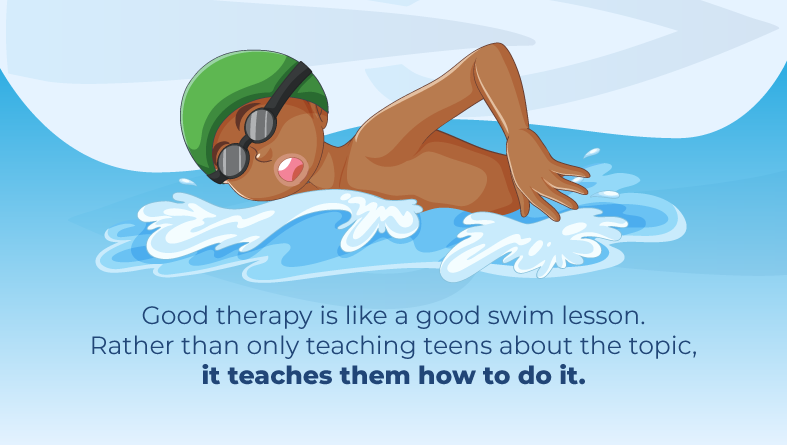
Teens need to learn through doing. And, like any area of life, they need lots of practice to get good at it. Nobody becomes a proficient swimmer after one lesson.
Looking at the session in the video, are any of those kids going to be able to “swim” after a session like that? Definitely not. Even if the therapist had assigned a skill to practice, getting 2-5 minutes of practice time per session is not going to lead to proficiency.
If that’s an example of what we don’t want to see, then what should group therapy look like? Obviously, the opposite of the above.
It should be engaging. Now, engaging doesn’t necessarily mean fun. Therapy is hard work. It is often difficult. Your average teen is not going to come out of a therapy session and tell you how much fun they had today.
Instead, engagement means they’re involved. The therapist is using whole group facilitation techniques including lots of pair and small group work to ensure the teens are actively participating rather than spending most of their time listening to someone else talk.
Of course, good group therapy is also fun at times. Just like a good sports coach will include fun games as part of practice, a good therapist tries as much as possible to make session work fun or interesting as well, but, obviously, having fun is not the main goal or the only way to foster engagement.
Whole group facilitation definitely means they aren’t using a round robin facilitation style. Round robin is when everyone is asked to participate one at a time, which means one person speaking and 9-13 other kids just sitting around waiting for their turn. Unfortunately, round robin is the most common facilitation style you’ll see used across the country for teen group therapy. (You can ask here, if it’s so ineffective, why is it the most common and the simple answer is that no one teaches therapists how to use whole group facilitation techniques. Whole group facilitation is not taught at university, it’s not taught by supervisors during licensing, and most programs don’t use it, so they don’t learn it on the job either. Bricolage is unique in that we have a dedicated onboarding program and structured curriculum that focus on whole group facilitation.)
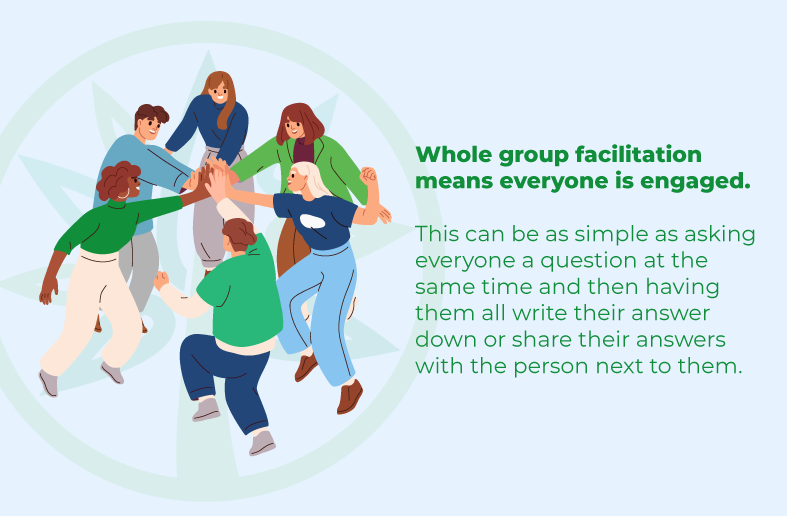
Whole group facilitation means everyone is engaged. This can be as simple as asking everyone a question at the same time and then having them all write their answer down or share their answers with the person next to them. That way every teen is engaged all the time. More advanced techniques are collaborative group projects, presentations, and role plays.
Great group therapy includes a lot of practice. We’re not just talking about problems, we’re identifying solutions and then actively practicing them. For a teen struggling with suicidal ideation, this could be learning to identify negative thoughts and then restructuring them. For a child struggling with hyperactivity, this could be practicing meditative or self-calming techniques. For a child with social anxiety, this could be practicing conversation starters and learning how to make small talk with strangers.
The key is practice, practice, practice. Depending on the child’s particular issues, they need targeted interventions designed specifically to facilitate thought and behavior pattern change. Each intervention consists of a knowledge and a skill component. The skill component must be practiced again and again and again until the child achieves proficiency so they can manage their thoughts and behaviors outside of the walls of therapy in the real world.
Here at Bricolage Behavioral, our proprietary curriculum and unique therapist training program are specifically designed to foster engaging, productive, solution-focused therapy. Teens are engaged through a variety of multimedia and whole group facilitation techniques. In our groups, kids are constantly talking, working on themselves, and practicing recovery skills through extensive pair and group work. Sessions are designed to teach teens the most effective tools for overcoming their particular mental health challenges and then are given ample time to practice these skills in session with support from peers and our master’s level therapists.

Bricolage Behavioral Health is strength-based, skills-based, evidence-based, and medication-light. We empower your child or teen to develop the skills they need to take control of their mental health with effective, science-backed therapy.
At Bricolage Behavioral Health we believe that whole family healing affords your child the best chance for long term mental health and can put your loved ones on the path to a healthier, happier life.
Bricolage Behavioral Health
3204 Long Prairie Road
Suite A
Flower Mound, TX 75022
Mon - Fri: 8:30 AM–9:00 PM
Sat & Sun: 9:00 AM–5:00 PM