What does healing look like?
You probably pictured something physical, like a cut or broken bone. What about healing from a mental health condition?
That answer is a lot harder to come by. The evidence of healing varies from person to person. There is no brain scan, blood test, or other physical assessment that can identify the progress of mental healing.
Researchers have yet to see a healing brain with their own eyes, but we do have some knowledge about how a brain works to overcome mental health symptoms – and we’re happy to report that every brain is capable of it.
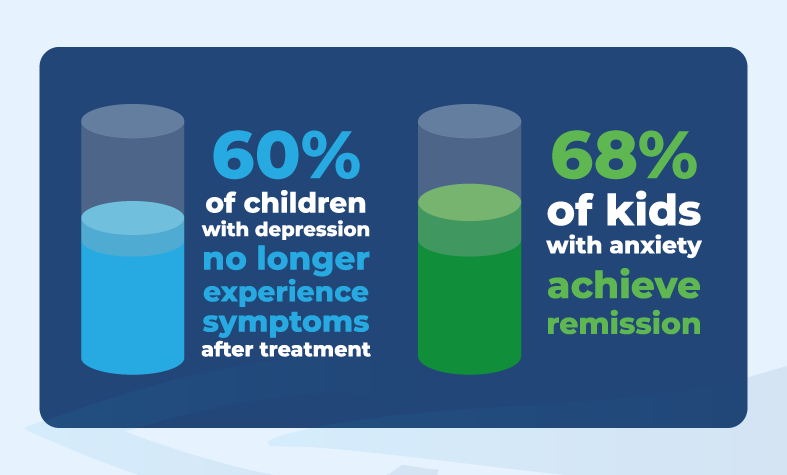
Even if you think you’ve tried everything and your child has yet to overcome their symptoms, don’t give up. As many as 60% of children with depression no longer experience symptoms after treatment, and up to 68% of kids with anxiety achieve remission. Your child’s brain is changing now, even as you read this. How does that happen? Even more importantly, what does it take for a brain to change for the better? We have a lot of experience working with kids and watching their mental health improve at Bricolage Behavioral Health. Let’s talk about the neurobiology of recovery.
You’re probably more familiar with the word “neuroscience,” but neuroscience and neurobiology are the same thing. It’s the study of the nervous system, including the brain, spinal cord, and every other nerve in your body.
We focus specifically on how the different parts of the nervous system influence thoughts, feelings, and behavior. There’s a wealth of information to guide how we treat the kids in our care and help them overcome their mental health symptoms. Our emphasis on neurobiological factors makes Bricolage unique.
You might be surprised to know that genes and chemical imbalances are rarely the primary cause of mental health conditions.
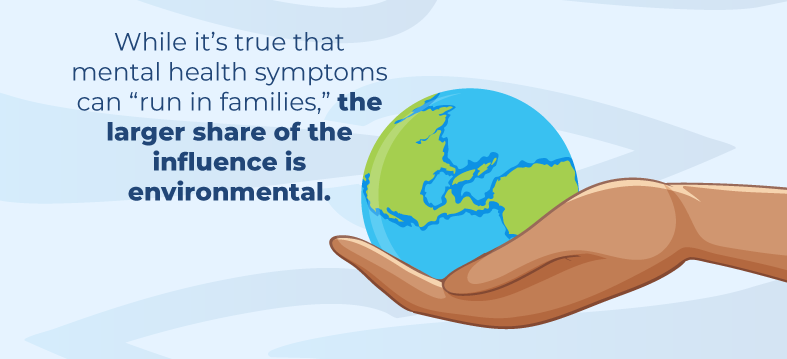
Despite their best efforts, researchers have yet to find a gene that “causes” any mental health condition. While it’s true that mental health symptoms can “run in families,” the larger share of the influence is environmental. You may have also come across heritability studies purporting some large percentage of a behavioral trait to be genetic.
These comments are incredibly misleading. In fact, due to the heterogeneous nature of study participants, in any large sample size, we'll find 30% of all study participants have similar traits whether this is religion, political leanings, divorce rates, sexual orientation, mental health states, or anything else. While you may see an adoption twin study report 50% "heritability", this doesn't discount the 30% baseline finding for all common cultural traits (in addition to other inaccuracies in interpretation).
It’s possible that our genes make us more susceptible to certain behaviors and feelings than others, but think of it this way: lung cancer can also run in families. That doesn’t mean you’re guaranteed to get lung cancer eventually. If anything, it makes you more aware that it could be a problem in the future so you can take steps to make it less likely, such as avoiding smoking. That significantly reduces your chance of developing lung cancer despite any genetic predisposition to the illness. Genetic predispositions are sort of like a whisper in the ear. They have some small influence but don’t determine behavior.
It’s the same for mental health conditions. You could even take the same approach. If many people on the mom’s side of a child’s family experienced depression, their parents could teach them strategies to manage symptoms of depression early and significantly reduce the child’s chance of being seriously impacted by depression in their life. Of course, strategies for managing depressive symptoms aren’t nearly as straightforward as avoiding smoking – that’s why therapy can be so helpful for anyone, even at a young age! It just means depression is not an inevitability for the child, regardless of their family history with mental health conditions.
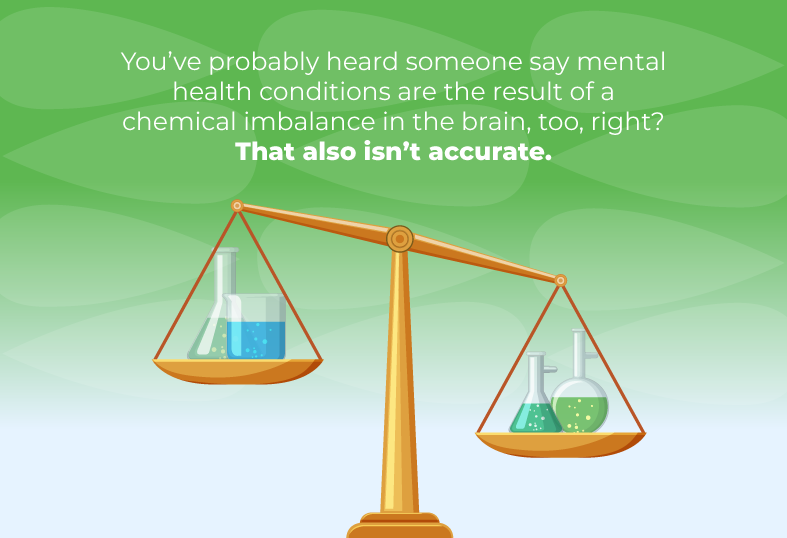
You’ve probably heard someone say mental health conditions are the result of a chemical imbalance in the brain, too, right? That also isn’t accurate. Research has disproven this theory repeatedly.
Our neurotransmitters – the chemical messengers in the brain people are usually referring to when they mention a “chemical imbalance” – constantly change in response to the world around us. Every brain is different, too. Because of this, there is no standard to compare people’s neurotransmitters to or any real way of measuring the level of chemicals in someone’s brain in the first place. If mental health conditions were due to a chemical imbalance, we wouldn’t know what level of neurotransmitters would count as “healthy” or what the neurochemical makeup of each mental health condition would look like.
You might wonder why medication that claims to correct chemical imbalances in the brain still works for some people. Truthfully, we aren’t entirely sure yet, and more research is conducted on this every day. The placebo effect and belief that medications can improve mental health are very powerful and are responsible for some of this. Of course, antidepressants and other medications aren’t just sugar pills – they do have tangible effects on our brains.
Current SSRIs and other medications have a global impact on the brain, much like alcohol, opioids, or other substances that impact our brains. Alcohol, for example, reduces our inhibitions, which reduces social anxiety for many people. Prescription medications have a similar global impact with various outcomes. However, just like alcohol does not correct a chemical imbalance, neither does an SSRI. By flooding the brain with various chemicals, whether alcohol or lithium, substances and medications can impact our moods, feelings, and reactions – but only while they’re in our system.
Some people might find comfort in the chemical imbalance theory. It means their mental health symptoms aren’t their fault – and in many cases, that’s still true. Think of it a different way, though: it means you have more control over your mental health than you originally thought. It means that you can still get better even if medication hasn’t worked for you. It just requires some new skills and additional help.
The amazing thing is that our brains are always changing, no matter how old we are. They adjust to our environment and experiences to help us function to the best of our ability in every moment. By the time you finish reading this page, your brain will be different than it was before! The brain’s ability to change is what we call “neuroplasticity.”
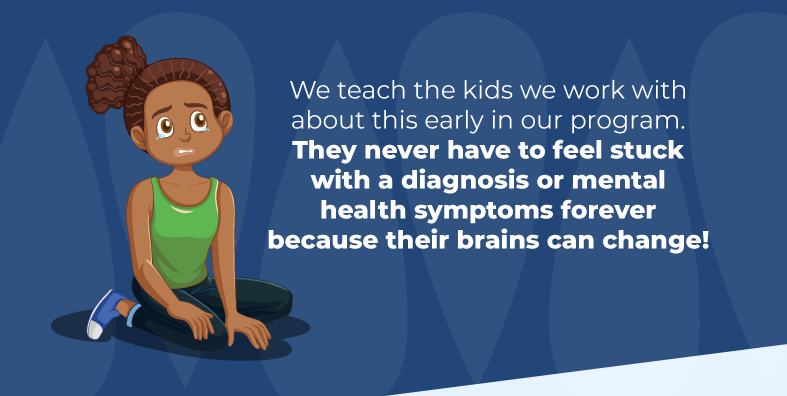
We teach the kids we work with about this early in our program. They never have to feel stuck with a diagnosis or mental health symptoms forever because their brains can change! It’s also easier for teens than adults because their brains have had less time to learn the world and cement beliefs, behaviors, and thought patterns into place. Their brains change more easily. They are literally less “set in their ways.” This can be a source of hope, too, both for children and their parents.
Your brain wants to save as much energy as possible. Because of this, it creates “neuropathways” for things and processes you engage in frequently. These help your brain send the necessary signals to execute these processes without spending too much energy.
Think of them like roads. You’re not going to take the longer route through the backroads to work every day when you can just take the highway and get there in half the time with half the effort.
Your brain operates the same way. Why would it create new neuropathways when it can just use the tried-and-true easy way? To make matters more difficult, these neuropathways only strengthen and reinforce themselves the more you use them. Like a highway, other neurobiological “roads” are built off of the strongest neuropathways, making that main road all the easier to access and travel down.
Change takes a lot of effort from your brain. That effort is tiring and can strain your brain's finite energy budget. Those frequently utilized neuropathways are so hardwired into your brain that it feels unnatural to take any other “roads.” This is another reason change can be so hard. What we're used to feels "natural" even when what we're used to isn't the best for us. Parents often tell their kids to "sit up straight." But doing so doesn't feel comfortable. This isn't because sitting up straight is uncomfortable, it's because your brain and body aren't used to it. Get into the habit, and suddenly slouching will feel unnatural!
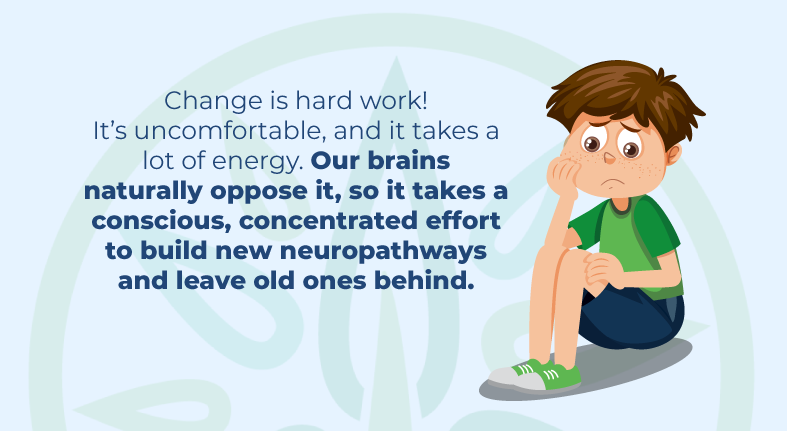
This is your brain’s logic when trying to break bad habits, restructure negative thought patterns, and correct harmful behavior. It’s so used to utilizing the neuropathways involved in those processes that it resists changing course. Change is hard work! It’s uncomfortable, and it takes a lot of energy. Our brains naturally oppose it, so it takes a conscious, concentrated effort to build new neuropathways and leave old ones behind. It takes even more effort to erase those dysfunctional neuropathways altogether. Until then, they hang around, always the tempting, more convenient option.
Exactly what we do to initiate change for the kids we work with depends on the symptoms they’re managing. We teach healthy coping mechanisms, how to better regulate emotions, stress management techniques, communication skills, and more. Most importantly, however, we teach our kids how to restructure dysfunctional thoughts and habits into something more helpful.
At Bricolage, we’re not so concerned with diagnosing a disorder. Instead, we’re focused on the “why.” What is causing your child’s feelings or behavior? Someone who is depressed because they just lost a loved one requires different interventions than someone who is depressed because they can’t seem to make friends. The former child needs help coping with grief, while the latter needs to improve communication skills or confidence.
How exactly do we do that? It takes a lot of practice and repetition. If we teach a teen a skill to improve their mental health, just learning it isn’t enough to rewire neuropathways. It takes practice, reinforcement, and more practice. We do this by teaching and practicing the skills through different mediums, like videos, readings, journaling, and discussions. This better cements concepts in the kids’ minds, and connects new “roads” to more easily access the new neuropathway. Personal practice is what really matters, and that’s why we place such an emphasis on it in our group therapy, too.
Prediction errors are also crucial to creating new neuropathways and reshaping old ones. A prediction error is something that challenges your natural assumptions. For example, someone with OCD might believe they will get sick and die if they don’t wash their hands repeatedly.
In this case, a prediction error would be the person staying healthy if they don’t wash their hands. Your brain naturally stores prediction errors and uses them to update your belief systems. However, it takes a lot more than one prediction error to disrupt a well-established neuropathway. It requires repetition, as well as an alternative skill, or neuropathway, to practice instead of the dysfunctional one. With enough repetition, your brain will use the productive neuropathway more often than the harmful one. We utilize prediction errors and repeatedly challenge our kids’ dysfunctional thought and behavior patterns to promote change.
Emotion also significantly impacts the forging of neuropathways. Someone who experiences a horrifying traumatic event creates a neuropathway related to that event quite easily due to the intensity of those emotions. That event is also easy to recall. Thankfully, the opposite is also true – positive emotions influence neuropathways more substantially than neutral feelings. We try to inspire emotions in our kids, especially happiness and laughter, as they learn.
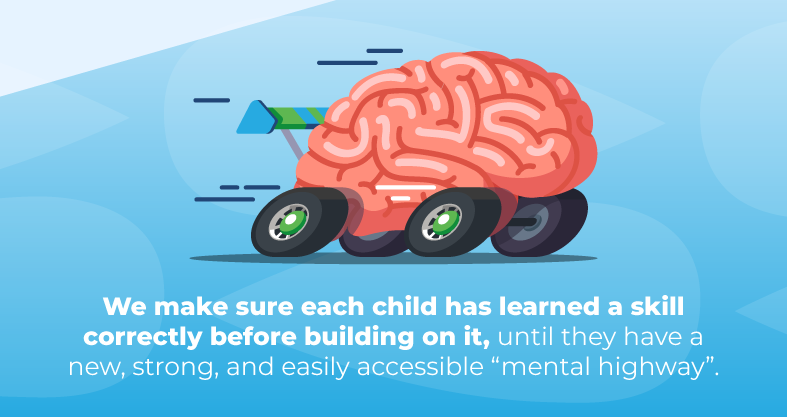
Of course, every child has a lot to learn when they enter our program. We don’t just bombard them with information or start with complex concepts first. We start simply, ensuring they have a firm and functional foundation, then build up to more difficult concepts. It’s just like any other way you learn in school. You wouldn’t try to teach a young child math by starting with an algebraic equation. You teach addition first, then subtraction, and so on. We treat creating new neuropathways and learning healthy strategies the same way. We make sure each child has learned a skill correctly before building on it, until they have a new, strong, and easily accessible “mental highway” to replace their negative one.
Your child can always get better. Their brain is capable of change. They can adopt new behaviors and leave behind unproductive ones. They can alter their mindset and approach life from a healthier angle. There are many ways to break their brain out of its current state and empower your child to grow and improve. Here at Bricolage, we identify what’s preventing your child from healing, then implement the most effective interventions based on their needs and goals.
You shouldn’t expect to have all the answers. You are only human and most likely not a mental health professional or neuroscientist yourself. That’s where getting an expert (or several) in your corner can be so helpful when in the treatment of mental health disorders. They’ll kick your child’s brain into gear and equip them with the strategies they need for positive change.
At Bricolage Behavioral Health, we treat your child’s “why.” That means we look beyond any diagnoses at the top of their treatment plan and delve into the root causes of their symptoms. That’s what it takes to promote true healing. While medication can be a great tool to aid in this process, it’s only one potential part of a comprehensive treatment plan. Recovery takes work, patience, and the belief that change is possible. Contact us and call 469-968-5700 today for more on how we can help your child.
Bricolage Behavioral Health: Where Teen Minds Matter

Bricolage Behavioral Health is strength-based, skills-based, evidence-based, and medication-light. We empower your child or teen to develop the skills they need to take control of their mental health with effective, science-backed therapy.
At Bricolage Behavioral Health we believe that whole family healing affords your child the best chance for long term mental health and can put your loved ones on the path to a healthier, happier life.
Bricolage Behavioral Health
3204 Long Prairie Road
Suite A
Flower Mound, TX 75022
Mon - Fri: 8:30 AM–9:00 PM
Sat & Sun: 9:00 AM–5:00 PM