“You just need to make them go to school. What’s so hard about that?”
If you have a teen experiencing school avoidance, you’ve probably heard something similar before.
School avoidance is exactly what the name suggests: a child avoiding going to school. A life impacted by school avoidance includes an abundance of absences, missing out on important opportunities, and a lot of unaddressed turmoil.

Parents of kids who don’t have any trouble going to school often just don’t get how difficult it is to live with school avoidance. There are a lot of people who do understand, though. More than 900,000 Texas youth missed a tenth or more of the school year due to absences in 2022-2023. Some miss well more than that.
It might feel like the top priority should be getting your teen back to their education, but even if you do manage that, it’s not a true fix. Sending them back without addressing the root of their discomfort with school will only take a larger toll on their mental health, and the school-avoidant behavior could return at any moment. You need to get to the bottom of their feelings.
At Bricolage Behavioral Health, we work with all kinds of teens, including those experiencing school avoidance. We’ve seen them grow, heal, and successfully finish out their education. We’ll delve into what you need to know about school avoidance and how you can help in this blog.
School avoidance is sometimes referred to as “school refusal,” but it’s a bit of an outdated term. “School refusal” comes with a more negative connotation, and it sounds like an accusation against the teen. “School avoidance” is more neutral and doesn’t insinuate that the teen avoiding school is automatically in the wrong. School avoidance and school refusal are the same thing, but we say “school avoidance” because it better acknowledges that something deeper is going on. If a teen is refusing to go to school, they’re just being obstinate. If a teen avoids school, we’re more inclined to ask, “Why?”
If you have a school-avoidant teen, you’ve probably received plenty of truancy notices in the mail. Truancy is usually defined in the school’s handbook, and in Texas, it involves reaching ten unexcused absences in a six-month period. It’s typically associated with children choosing not to go to school for no good reason. Many people might consider school-avoidant teens truant by this definition. However, it’s important to realize even teens with “no good reason” to skip school have plenty of reasons for it. Deciding the teen’s reasoning isn’t good enough ultimately does nothing to help them.

Answering this question is key to getting your teen back in class, and it’s different for every child. Here are some common reasons for school avoidance:
Often, teens avoid school for multiple reasons, and whether they’re on this list or not, it’s important to take them seriously. These concerns are causing your teen enough distress for them to avoid a major opportunity for growth. That’s important to remember, too: Your teen is in distress. If they weren’t, they would be going to school.
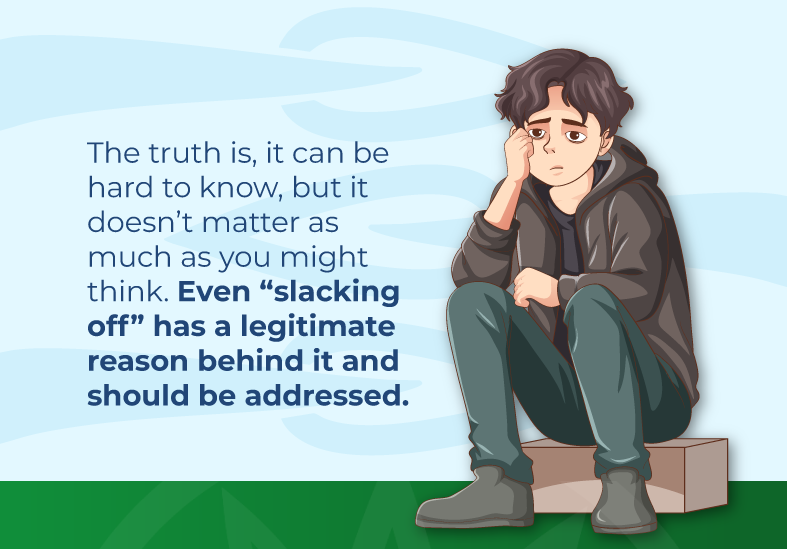
This is a concern for a lot of parents! The truth is, it can be hard to know, but it doesn’t matter as much as you might think. Even “slacking off” has a legitimate reason behind it and should be addressed. Has treating your child like they’re lazy and just behaving badly ever helped anything? Probably not, right? The situation requires patience and compassion, no matter what.
Let’s take a moment to think about why a teen you might label as lazy doesn’t want to go to school. Maybe they just don’t find anything they’re learning engaging, or they think school is a waste of time. In this case, it might be appropriate to talk to them about how important getting an education is, with examples. You can tell them that people who don’t finish high school have the highest unemployment rate and earn the least money. You could also contact their school and let them know what’s going on. Their guidance counselor might have some ideas on how to motivate your child and make school more rewarding.
It’s also possible that this teen is managing some depression symptoms. Depression is more prevalent in teens than in any other age group, with 19% of teens in one study reporting depressive symptoms in the past two weeks. This is a very real concern, even if you don’t think your child has reason to be depressed. Keep in mind that they are growing up and experiencing a lot of changes. It’s a turbulent time in their lives, and they might be dealing with more than you realize.
Of course, some discipline might be necessary. If your teen is playing video games all day instead of getting an education, it’s a good idea to intervene, and at the very least, limit the time they spend playing games on weekdays. You can consider confiscating their phone during regular school hours so they don’t spend their time on social media, too. This might be enough for a teen who finds school boring to go back, because staying home is now even more boring.
Finding the answer to this question is probably why you clicked on this article in the first place, but unfortunately, there isn’t a simple answer. Every teenager is different, and what works for one might cause significant harm to another.
The first step is to talk to your teen and ask them openly and honestly why they don’t want to go to school. Approach them calmly, with compassion, and with the intention to understand their situation. If you give them a reason to get defensive, they’ll easily shut down and refuse to open up. Starting with something like, “I’m concerned about how much school you’re missing. Why don’t you want to go?” might help.
There’s a high chance your teen won’t entirely know the answer. You might get an “I don’t feel like it,” or “I don’t know.” Have them write a list of what they like and dislike about school. This will offer more insight into their motivations for both of you. They’ll probably write things like “exams” and “algebra,” but they might offer other helpful specifics. Even the broad “expected” teen answers help, too. If you know they dislike exams and algebra, you can try to find ways for them to be more tolerable, for example.

Involve your teen’s school and a mental health professional, too. School avoidance isn’t just a matter of poor discipline or laziness. There is something deeper going on. A therapist can help you get to the bottom of why your teen doesn’t want to go to school, and provide concrete strategies to help them overcome school avoidance. School officials are usually happy to work with families and accommodate teens so they feel more comfortable in class, too. As long as you keep them in the loop and the school knows your teen isn’t just skipping school for fun, you shouldn’t have to worry about truancy, either.
Make it a non-negotiable. Be firm and let your teen know that missing school is not an option. School avoidance was not nearly as prevalent even 20 years ago as it is today and, for the most part, it's because parents made going to school a non-negotiable. You may be concerned that your teen will get upset or angry with you or maybe you just want to avoid the conflict. But if your teen knows it's a non-negotiable, they may fight you on it at first but will eventually simply accept that they have to go.
Some parents find the hardline approach difficult to enforce or not appropriate for a variety of reasons. Another approach is making it unattractive to miss school. Most teens, when avoiding school, will try to spend the time alone in their room. For teens with anxiety or fears around school, this can act as a positive reward, which only reinforces the behavior. Not to mention that most teens these days have TVs, video games, computers, cell phones, and a variety of other activities they find fun and interesting in their rooms. Teens avoiding school should not be allowed access to these entertainments or distractions.
Instead, have consequences in place. If they stay home from school, then they are required to clean the entire house or do yardwork instead. Maybe they lose privileges such as having access to their phone or the TV being removed from their room. The goal is to create a home environment that is unattractive for the teen to stay in.
If you try different strategies and nothing seems to make your child comfortable at school, it might be worth considering online classes or homeschooling. This can be a useful strategy when in-person school is the primary source of their anxiety. Maybe they are having problems with friends or there is a malicious rumor circulating that they are struggling with. In those cases, homeschool options combined with therapy can be a helpful combination to teach them how to deal with the situation before heading back.
The key is that they do learn skills to handle whatever they find challenging about attending school. What we don't recommend is homeschooling as an avoidance strategy. We want our teens to get pushed outside their comfort zones in order to develop the skills necessary for in-person interaction, even when faced with challenging situations. Intensive therapy programs can provide that bridge back to in-person school.
School avoidance is stressful for everyone involved. You want to make sure your teen gets the education they need to succeed, and they might see avoiding school as a matter of life or death. You’ve probably had countless arguments over it by now. Your entire family is likely exhausted.

School avoidance is a serious concern, and it isn’t always easy to just make your child go to school. Your family doesn’t have to manage school avoidance alone. Don’t be afraid to reach out for help.
Bricolage Behavioral Health is a youth mental health center center serving Flower Mound, TX, and surrounding areas. We look beyond any diagnosis a child receives at the big picture of their mental health, and pay careful attention to every part involved. We’ll focus on your child’s school avoidance in individual therapy and our unique whole-group therapy, addressing and empowering them to overcome any other obstacles they encounter along the way. Are you ready to help your teen heal and become the best version of themselves? Call 469-968-5700 today.

Bricolage Behavioral Health: Where Teen Minds Matter

Bricolage Behavioral Health is strength-based, skills-based, evidence-based, and medication-light. We empower your child or teen to develop the skills they need to take control of their mental health with effective, science-backed therapy.
At Bricolage Behavioral Health we believe that whole family healing affords your child the best chance for long term mental health and can put your loved ones on the path to a healthier, happier life.
Bricolage Behavioral Health
3204 Long Prairie Road
Suite A
Flower Mound, TX 75022
Mon - Fri: 8:30 AM–9:00 PM
Sat & Sun: 9:00 AM–5:00 PM